
Wilhelm en Maurits van Nassau Princen van Orangien haer leven en bedryf
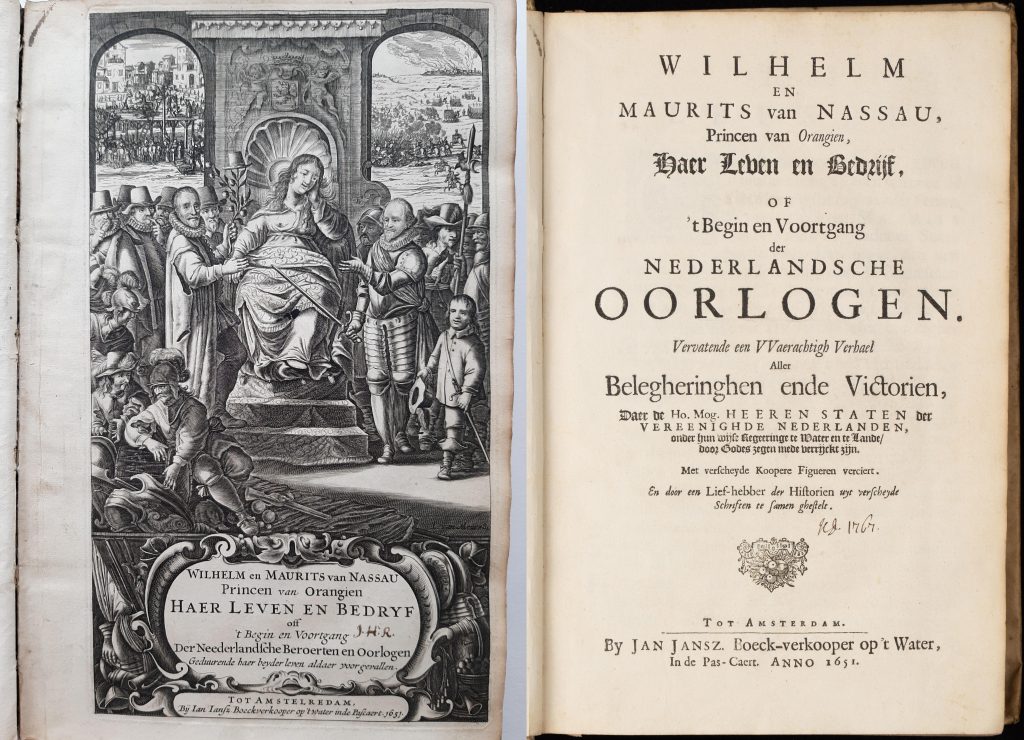
Isaac Commelin’s Wilhelm en Maurits van Nassau Princen van Orangien haer leven en bedryf is an enlarged mid-seventeenth-century history of William the Silent and his son Maurice of Nassau, two central figures in the Dutch Revolt and the formation of the Dutch Republic. Published in Amsterdam by Jan Jansz. in 1651, the work draws on Jan Jansz. Orlers’s earlier 1610 account, but expands it into a more ambitious illustrated history of the House of Orange-Nassau, Dutch military achievement, and the Republic’s wider maritime world.
The book combines dynastic biography, patriotic history, military narrative, and illustrated geography. William the Silent is presented as the foundational leader of resistance to Spanish Habsburg rule, while Maurice appears as prince of Orange, stadtholder, and military commander. The narrative follows the progress of the Dutch struggle by land and sea, giving visual and textual attention to sieges, battles, fortified towns, naval encounters, and political events. Its engraved portraits, maps, plans, city views, and historical plates place the Orange-Nassau dynasty within the military and civic history of the Dutch Republic.
Commelin’s 1651 enlargement also broadens the work beyond the Netherlands. It incorporates episodes from Dutch overseas activity in Brazil, the East Indies, and the Arctic, reflecting the extent to which Dutch national identity in the seventeenth century was tied to navigation, commerce, war, and colonial expansion. The Arctic material includes Willem Barentsz.’s search for a Northeast Passage, an enterprise associated with Maurice’s patronage. The volume also includes the image of the dodo on Mauritius, the island named in honour of Maurice of Nassau, linking dynastic commemoration to Dutch expansion into the Indian Ocean.
This volume is closely connected with other works in the collection that connect Dutch history, navigation, and overseas expansion. Van Keulen’s world and sea charts (138, 182, 83, and 95) show the later hydrographic world shaped by Dutch maritime activity, while the Jan Huygen van Linschoten volume and maps (71, 74, 254, 277, 278, and 279) provide an earlier context for Dutch access to Portuguese and Iberian geographical knowledge.
Commelin, Isaac (1598–1678)
1610, Amsterdam: Jan Jansz. Orlers
1651, Amsterdam: Jan Jansz.; enlarged edition by Isaac Commelin
Letterpress with copperplate engravings
350
R1 Extremely rare - occasionally seen on the market