
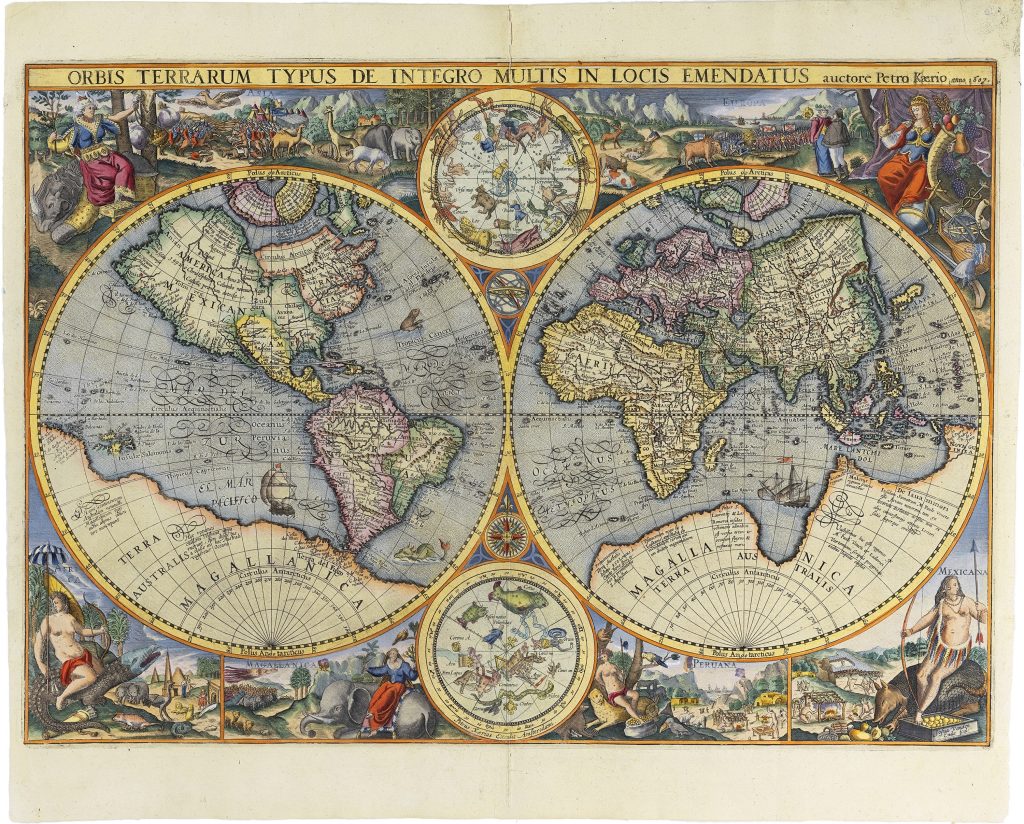
Orbis terrarum typus de integro multis in locis emendatus
Pieter van den Keere was a Flemish engraver, mapmaker, publisher, and globe maker who worked in London and Amsterdam. Around 1584 he left Ghent during the religious upheavals in the Low Countries and settled in London, where he trained as an engraver in the circle of his brother-in-law Jodocus Hondius I. His sister Coletta van den Keere married Hondius in 1587. In the 1590s Van den Keere moved to Amsterdam, where he became an important engraver and publisher within the Dutch map trade.
This double hemisphere world map was first published separately by Van den Keere in Amsterdam in 1604 and engraved by Josua van den Ende. It was based on Petrus Plancius's world map published a decade earlier (71), with changes in arrangement and detail. This example is the second state, with the date altered to 1607. The map presents the world in two hemispheres, surrounded by corner scenes and decorative elements derived from the late sixteenth-century Dutch world-map tradition. Its geography retains a large southern continent and reflects continuing European uncertainty about the far south, the Pacific, and the relationship between newly reported lands and inherited cosmographical models.
As a smaller separately published world map, it shows how the visual and geographical language of large wall maps could be adapted into a more compact format. Its relationship to Plancius also places it within the Amsterdam circle of mapmakers who transformed Iberian, Portuguese, and Dutch voyage information into printed world geography.
Within the collection, this map is closely connected with Petrus Plancius’s world map (71), Van den Keere’s larger world map (109and 122), and Jodocus Hondius I’s Orbis terrae novissima descriptio (199). Together, these works show how Dutch world-map design developed around 1600 through repeated adaptation, reduction, and revision.
Keere, Pieter van den (1571–1646)
Separate publication. Amsterdam: Pieter van den Keere, 1604
1607, second
Copperplate engraving
217
R1 Extremely rare - occasionally seen on the market