
Australian Agricultural Company - Map from Port Macquarie to Newcastle
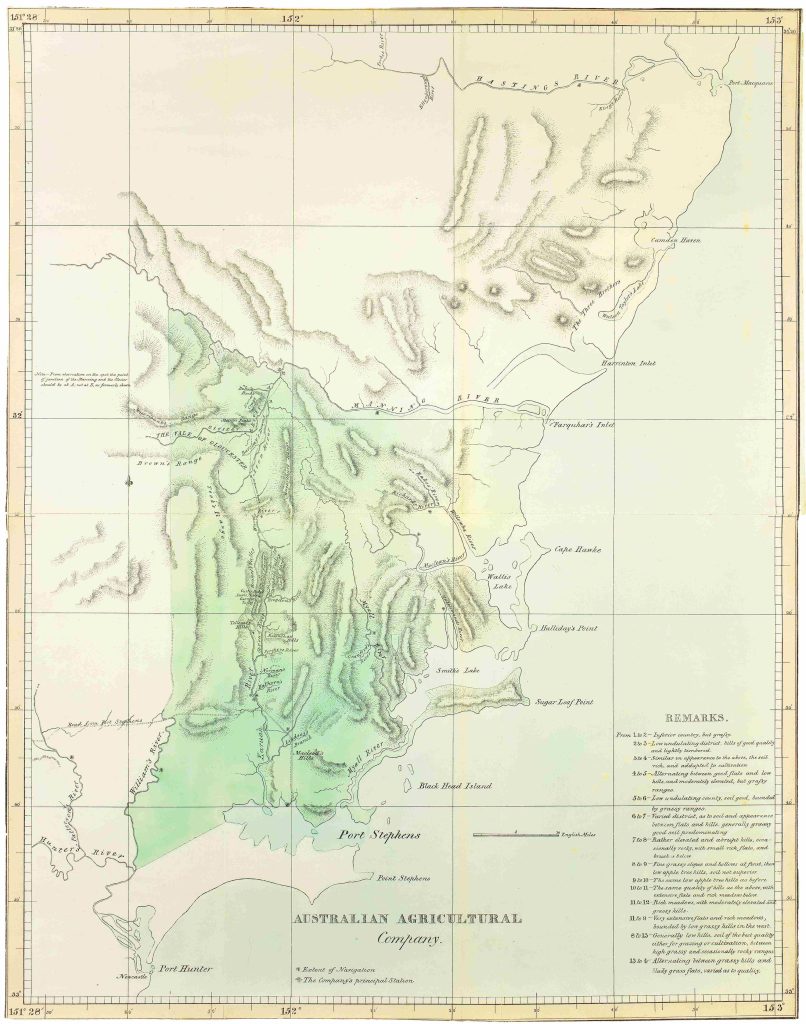
The Australian Agricultural Company (AACo.) was established by Royal Charter in November 1824, following an Act of the British Parliament enacted on 21 June 1824 (5 Geo. IV c. 86) (345). In exchange for a grant of one million acres of land in New South Wales, the company agreed to pay 1 shilling and 6 pence per acre, as well as an annual quit rent to the Crown. The company's goal was to advance large-scale pastoralism and agricultural improvement in the colony.
This map, believed to have accompanied the company's 1824 prospectus (see 246) or been issued shortly thereafter as part of its promotional and planning documentation, outlines the proposed or surveyed extent of AACo.'s land holdings. The area stretches from Port Macquarie to Newcastle, covering a vast swathe of coastal and inland terrain on the north coast of New South Wales. This broad delineation reflects the company’s exploratory approach to site selection in the early months of its operation, prior to the final allocation of land at Port Stephens.
In addition to marking major boundaries, rivers, and coastal features, the map includes fourteen manuscript-style annotations in the lower-right corner. These concise descriptions—such as “inferior country but grasy [sic]”—offer valuable insight into contemporary assessments of land quality, vegetation, and suitability for grazing. Such practical remarks illustrate the complex and often disappointing realities the company encountered as it sought to implement an ambitious imperial agricultural enterprise.
This map not only served a logistical and evaluative function but also contributed to the company’s narrative of enterprise, improvement, and colonial expansion. It stands as an important artefact in the visual and administrative history of one of Australia’s earliest and most influential corporate landholders.
Australian Agricultural Company
London: Ruthven & Co., 1828
1828, first
Copperplate engraving
37
R2 Very rare - one or two copies appear on the market