
Armillary sphere
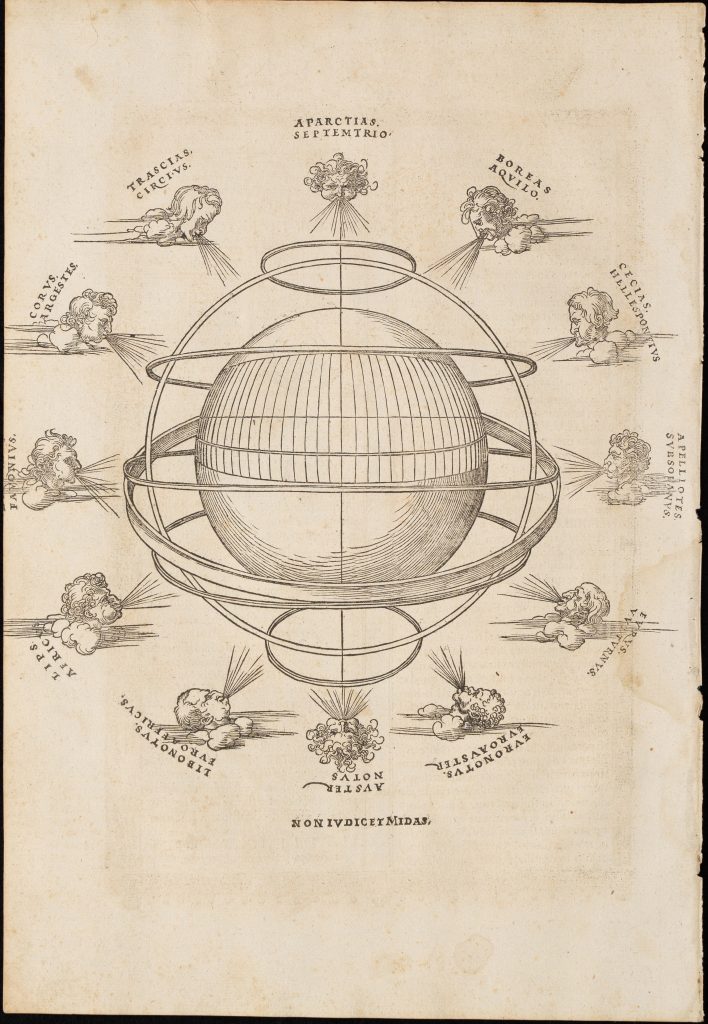
In 1522, the Strasbourg printer Johannes Grüninger issued a new edition of Ptolemy’s Geographia, edited by Lorenz Fries and based in part on the earlier work of Martin Waldseemüller. Its commercial success led to a further Strasbourg edition in 1525, with the text revised by the Nuremberg humanist Willibald Pirckheimer. This woodcut of an armillary sphere was included in that edition and is traditionally attributed to Albrecht Dürer.
Dürer was one of the leading artists of the German Renaissance, and his work extended beyond devotional and portrait prints into the visual culture of mathematics, astronomy, and geography. In contrast to the simpler sphere used in the 1522 edition (3), this version is more elaborate. It depicts a Ptolemaic cosmographical model surrounded by concentric rings and twelve wind heads, labelled with Greek and Roman names for the classical directional winds.
The attribution to Dürer rests partly on later art-historical tradition, including Johann David Passavant, and partly on contemporary correspondence. Two letters from Johannes Tscherte, court architect to Charles V, to Pirckheimer refer to the armillary sphere and associate it with Dürer. The letters also distinguish this elaborate image from a simpler sphere in the same book, described as being made only of lines and letters.
Rather than functioning only as a technical diagram, the woodcut turns cosmography into a learned visual image, bringing together mathematical order, classical geography, and Renaissance print design. It shows how Renaissance geography depended not only on maps, but also on images that explained the structure of the earth and heavens.
Dürer, Albrecht (1471–1528)
Ptolemy, Geographicae enarrationis libri octo, ed. Lorenz Fries, Strasbourg: Johannes Grüninger for Johann Koberger, 1525
1525, first
Woodcut
333