
Libri Cosmo harum rerum hanc sume figurationem
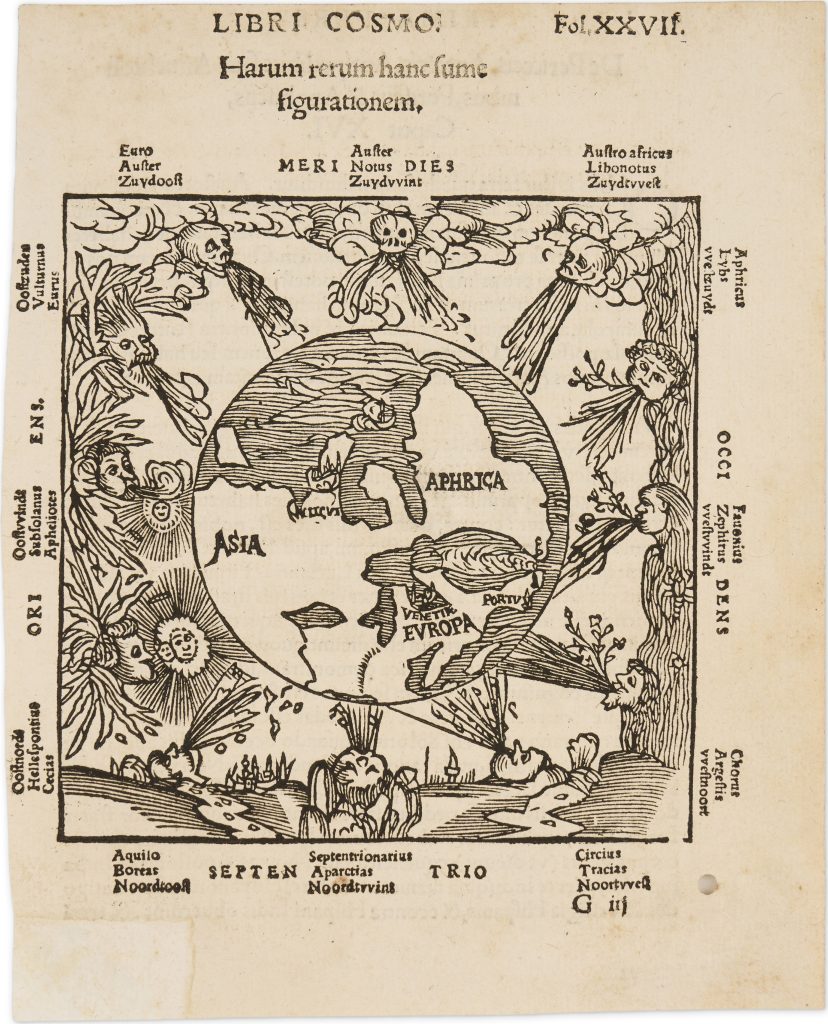
Peter Apian was a German mathematician, astronomer, mapmaker, and professor of mathematics at the University of Ingolstadt. His Cosmographicus liber, first published at Landshut in 1524, became a widely circulated introduction to cosmography, geography, astronomy, and mathematical measurement.
This woodcut world diagram presents the inhabited world in a traditional T-O format. Asia, Europe, and Africa are arranged within a circular ocean, with east placed at the top. The form draws on medieval and classical geographical conventions, but appears within a Renaissance printed manual designed to teach cosmographical principles.
The map is framed by twelve wind heads, each named in Latin and personified as a blowing figure. These winds connect the diagram to broader systems of direction, climate, and navigation. Rather than providing a navigational map, the image offers a simplified model of the world’s structure, suitable for teaching and memorisation.
In Apian’s cosmography, such diagrams helped readers understand the relationship between the earth, the heavens, and systems of measurement. The map therefore belongs to a tradition in which world images served not only to describe geography, but to organise knowledge. Its inclusion in Cosmographicus liber reflects the work’s broader aim: to make cosmographical learning accessible through text, image, and diagram.
Apian, Peter (1495–1552)
Cosmographicus liber, Landshut: Johann Weyssenburger, 1524
Woodcut
332
R2 Very rare - one or two copies appear on the market