
Allegory of citrus cultivation
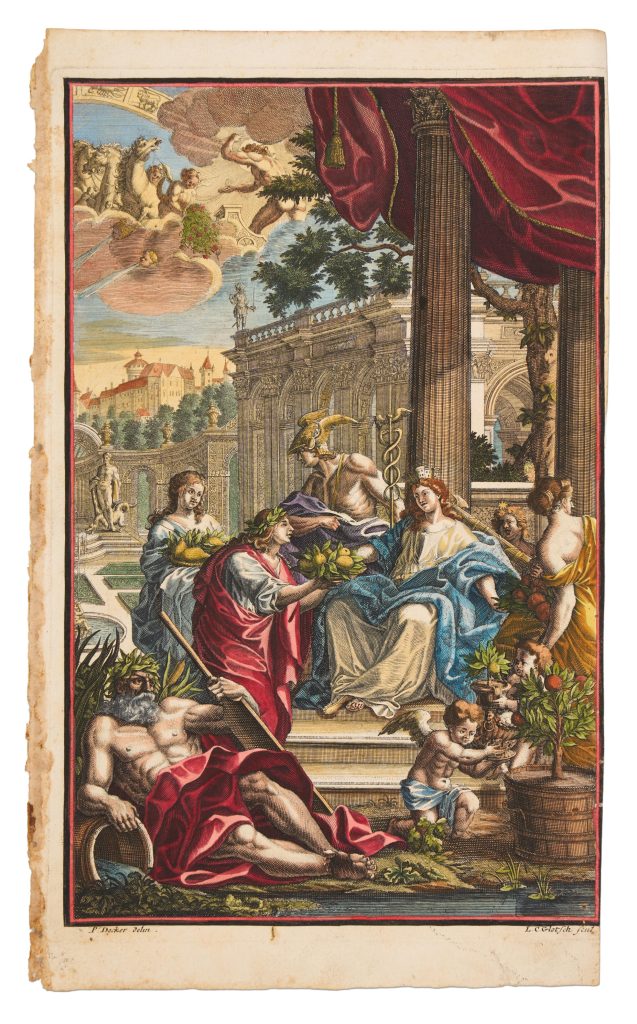
Johann Christoph Volkamer was a Nuremberg merchant, botanist, and citrus collector whose Hesperidum Norimbergensium was published in Nuremberg in 1713. One of the most elaborate early eighteenth-century works on citrus cultivation, it describes the culture and use of citrons, lemons, and oranges within the learned and mythological language of the Hesperides. This plate was designed by Paul Decker the Younger and engraved by Ludwig Christoph Glotsch.
The plate presents citrus cultivation as an allegory of abundance, water, garden design, and learned collecting. At the centre, a crowned female figure sits beneath rich drapery and receives citrus fruit from attendant women, who approach her with baskets and vessels filled with lemons or other citrus fruit. She may be understood as a personification of princely or cultivated abundance, or more generally as the presiding figure of the citrus garden. The women who bring fruit to her reinforce the association with the Hesperides, the mythological guardians of the golden apples.
At right, fruit-bearing citrus trees grow in wooden tubs, reflecting the practical reality of northern European citrus culture. In climates such as Nuremberg’s, citrus trees were cultivated in containers so that they could be moved, protected, and overwintered. Putti tend the plants and vessels, turning horticultural labour into decorative allegory. Their presence also links the scene to fertility, care, and the pleasures of the garden.
Water is a major theme throughout the composition. In the foreground, a reclining river god pours water from an urn, while the architecture behind includes fountains, pools, and garden statuary. At left, a nude classical figure stands among fish or dolphin-like creatures, further reinforcing the imagery of water, fertility, and cultivated pleasure. These details connect the plate with the mythological figure Arethusa, a nymph associated with springs and flowing water. Within the context of a citrus book, water is both a mythological attribute and a practical necessity for cultivation.
Mercury sits above the central figure, identifiable by his winged helmet and caduceus. His presence introduces ideas of exchange, communication, and learned transmission. In a book devoted to citrus fruit, Mercury can also suggest the movement of plants, knowledge, and luxury goods through trade networks. Volkamer’s citrus world was not only botanical but commercial and aristocratic: fruit, trees, gardens, and horticultural expertise circulated as signs of refinement and status.
The upper left opens into a celestial or mythological scene, with a chariot and horses appearing among clouds and rays of light. This gives the garden scene a larger classical frame, lifting citrus cultivation from practical horticulture into the realm of myth, poetry, and learned display. The formal architecture, fountains, statues, drapery, and carefully staged figures present the citrus garden as a cultivated theatre in which nature, art, water, and classical learning are brought together.
Johann Christoph Volkamer, Hesperidum Norimbergensium, Nuremberg: Johann Andreas Endter’s heirs, 1713
1713
Copperplate engraving
480
R3 Uncommon - dealers can usually obtain a copy