
Atlas Maior
Frederik de Wit was a Dutch engraver, mapmaker, and publisher whose business became one of the most successful Dutch map and print firms of the later seventeenth century. He moved from Gouda to Amsterdam around 1648 and, by 1654, was operating from premises on the Kalverstraat under the sign De Drie Crabben (The Three Crabs). In 1655 he changed the shop sign to Witte Pascaert (The White Chart), the name under which his firm became widely known. From his premises on the Kalverstraat, De Wit produced wall maps, atlases, sea charts, and town plans distinguished by elegant engraving, decorative richness, and fine colouring. His works remained influential into the eighteenth century and many of his plates were later acquired and reissued by Covens & Mortier.
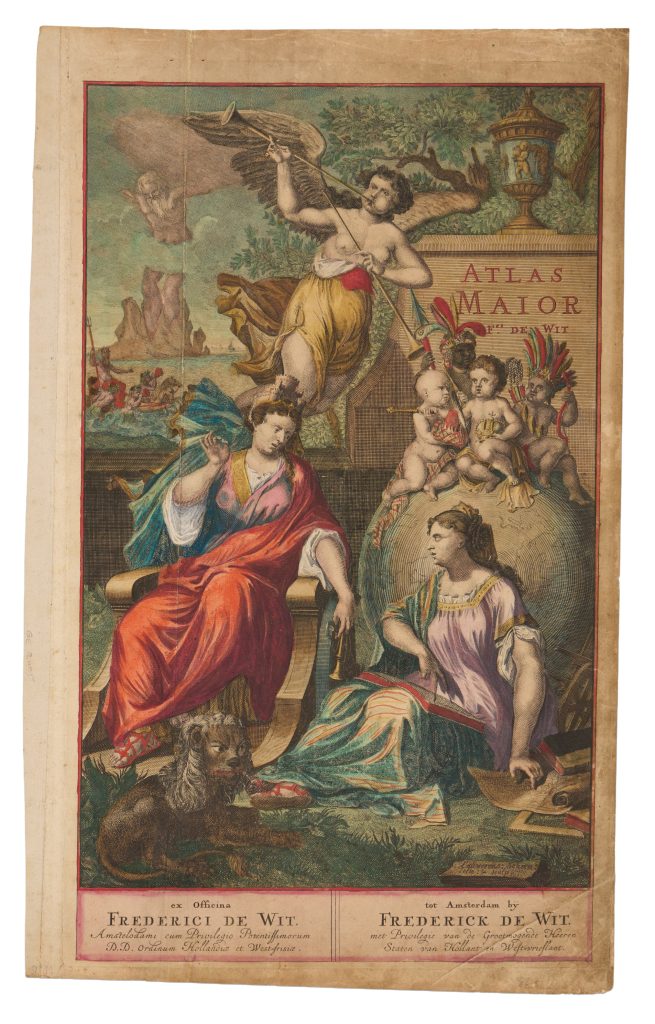
The engraved title page depicts an elaborate allegory of geography, commerce, and global dominion. At centre, a winged figure raises a billowing cloth or sail above an assembly of female personifications, putti, animals, and figures representing distant peoples. A globe, lion, maritime references, and richly coloured fabrics frame the atlas as a visual treasury of the world. The imagery presents De Wit’s Atlas Maior not simply as a collection of maps, but as a prestigious object of knowledge, display, and possession, linking Amsterdam atlas production with maritime trade, imperial ambition, and the ordered representation of the earth.
The title page is signed by Lauwerens Scherm, who designed and engraved the plate. Its allegorical imagery is characteristic of later seventeenth-century Dutch atlas frontispieces, where the title page served as a formal entrance to the atlas and as a statement of the publisher’s authority, ambition, and command of geographical knowledge.
Atlas Maior, Amsterdam: Frederick de Wit, c. 1688
1688, first
Copperplate engraving
485
R3 Uncommon - dealers can usually obtain a copy