
Asia wie es jetziger zeit nach den furnemesten herrschafften den fürnemesten Herrschafften abgetheilet und beschriben ist
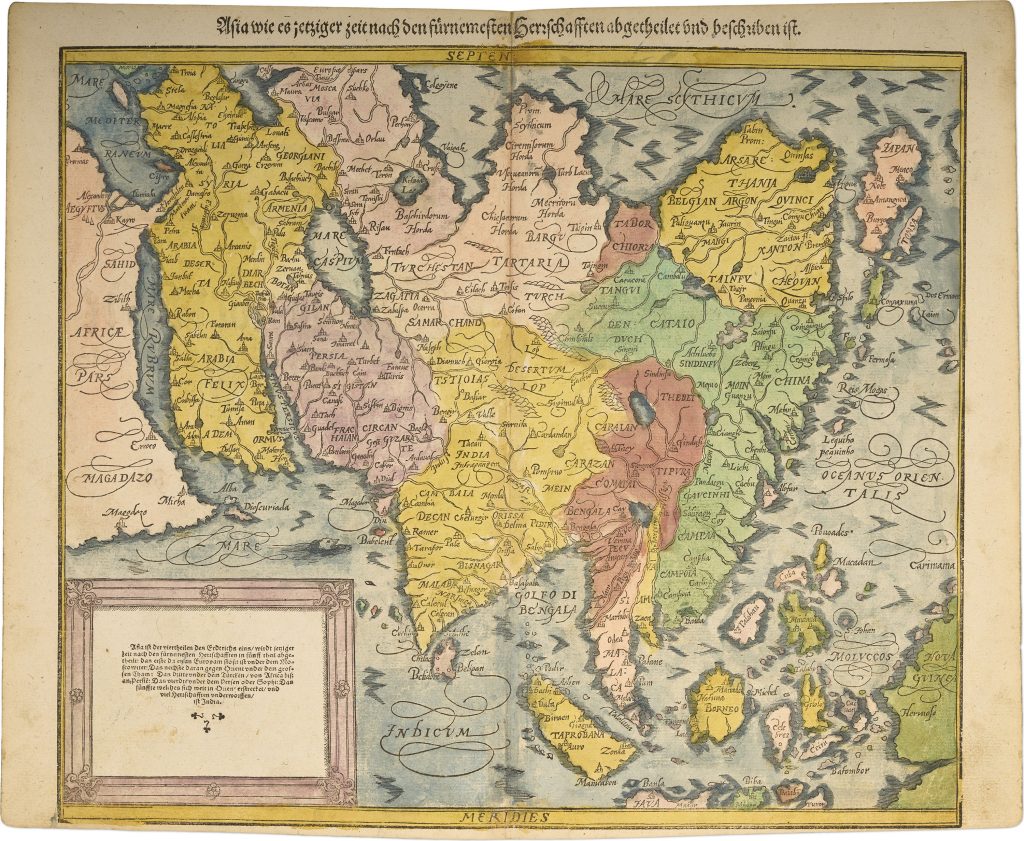
Sebastian Münster was a German humanist, Hebraist, cosmographer, and mapmaker based in Basel. His Cosmographia, first published in German in 1544, was a large illustrated description of the known world, combining geography, history, peoples, cities, natural wonders, and maps. Münster died in 1552, but the work continued to be revised and reissued by the Petri publishing family in Basel.
In 1588, Sebastian Petri issued a substantially revised version of the Cosmographia with a new set of woodcut maps. This map of Asia, from the 1592 German edition, belongs to that later Petri revision. It is therefore different from Münster’s earlier Asia maps, such as Asia Maior (232), India Extrema (5), and the later Italian version of India Extrema (96). Rather than following Münster’s mid-sixteenth-century geography, it reflects the updated map sequence prepared for the late sixteenth-century Cosmographia. The verso text introduces Asia as a vast region of lands and seas, with “countless islands, large and small, ” described “as they are known and described in our time.” This wording is important because it presents the map as current geographical knowledge. The map extends from the eastern Mediterranean, Arabia, Persia, and the Red Sea across India, Central Asia, China, Japan, Southeast Asia, the Moluccas, New Guinea, and the East Indies. Compared with Münster’s earlier maps, the geography is more detailed and more closely aligned with the later sixteenth-century mapping associated with Abraham Ortelius and other atlas makers.
Southeast Asia is especially prominent. The Malay Peninsula, Sumatra, Java, Borneo, the Moluccas, the Philippines, and New Guinea occupy the lower-right part of the map, placing the East Indies within a wider Asian framework. The map’s dense place names across Persia, India, Central Asia, China, and Tartary also show the Cosmographia’s ambition to present Asia as a connected world of kingdoms, routes, seas, islands, and regions.
Within the collection, this map is closely connected with Münster’s earlier Asia maps including Asia Maior (232), India Extrema (5), and Tavola della oriental regione dell’Asia (96). It also relates to Münster’s Sumatra map (395), which gives a more focused treatment of one of the key islands of Southeast Asia.
Münster, Sebastian (1488–1552)
Cosmographei oder beschreibung aller länder, Basel: Sebastian Petri, 1588
1592, second
Woodcut
394
R1 Extremely rare - occasionally seen on the market