
Beschryvinge van 't getakelde Schip met sijn loopende Tou-werck
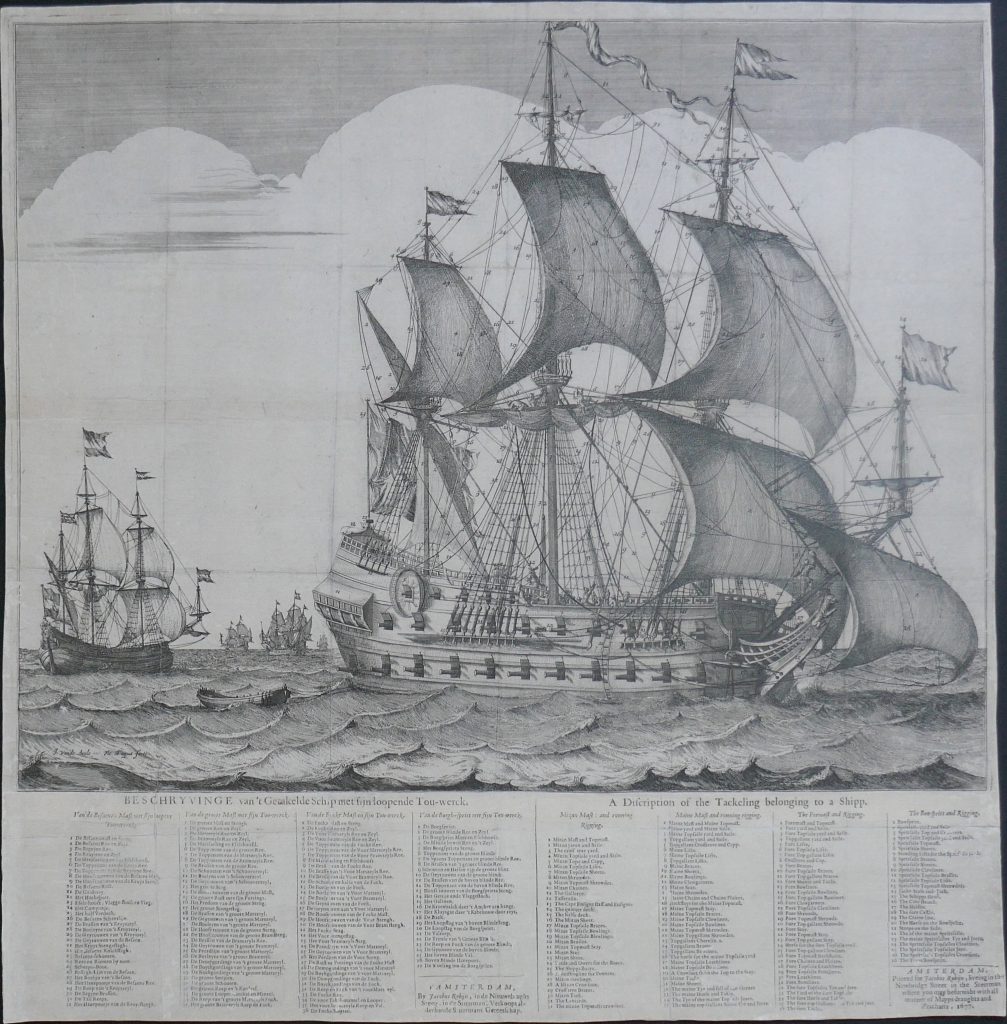
Johannes Jacobsz. van de Avele was a Dutch printmaker active in Amsterdam in the late seventeenth and early eighteenth centuries. This large bilingual Dutch and English broadside was engraved and etched by Van de Avele for the Amsterdam chart and nautical-instrument seller Jacobus Robijn in 1677. It presents a fully rigged VOC East Indiaman as a technical subject, combining a large image of the vessel under sail with numbered explanatory keys identifying its masts, spars, ropes, and tackle.
The print belongs to a practical visual tradition in which maritime knowledge was organised for study through labelled images. The ship is shown in profile, with its standing and running rigging carefully differentiated and keyed to explanatory text below. The bilingual title makes clear that the sheet was intended not simply as a marine view but as an instructional image, allowing Dutch and English readers to connect nautical terminology with the physical arrangement of the vessel.
The sheet legend identifies 135 mast and rigging components, divided into Dutch and English columns for the mizzen mast, main mast, foremast, and bowsprit. This reflects the centrality of shipping, navigation, and maritime trade to Amsterdam’s print culture in the later seventeenth century. Rather than representing a specific voyage or geographic region, it visualises the technical infrastructure that made long-distance seafaring possible: the ordered system of masts, yards, lines, and tackle by which a square-rigged vessel could be controlled at sea.
Aveele, Johannes Jacobsz. van den, (c. 1655–1727)
Separate publication. Amsterdam: Jacobus Robijn, 1677
1677, first
1686, second; 1701, third
Copperplate engraving
214
R1 Extremely rare - occasionally seen on the market