
L’isle de la ville de Batavia
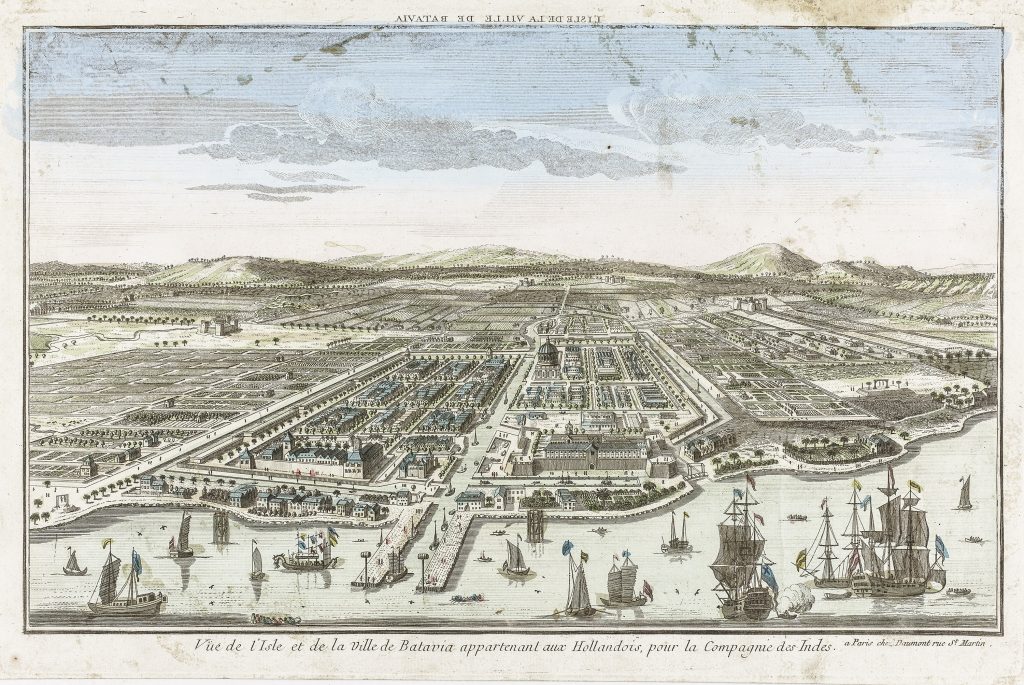
Jan van Ryne was a Dutch-born artist and engraver active in London, where he produced views of overseas cities and trading places for the British print market. Robert Sayer was a London publisher known for popular prints, maps, optical views, and illustrated geographical material. This perspective view of Batavia, the Dutch colonial capital now Jakarta, was first published by Sayer in 1754 (184). The image was later copied and reissued in Paris by Jean-François Daumont around 1780 in reversed form for optical viewing.
The reversed image and lettering are central to its function. Optical prints, or vues d’optique, were designed to be seen through a viewing machine fitted with a lens and mirror, which restored the image and enhanced the illusion of depth. The title L’isle de la ville de Batavia appears reversed above the view, while the caption below identifies Batavia as belonging to the Dutch for the East India Company.
The view presents Batavia as a fortified city surrounded by water, with canals, walls, shipping, and a regular urban plan. It shows the city looking south, with south at the top and north at the bottom. This orientation and the optical reversal remind us that the print was made less as a conventional map than as a visual entertainment and educational image for European audiences.
Within the collection, this print is closely connected with Jan van Ryne’s earlier London version (184), from which it derives. It also relates to Georg Balthasar Probst’s De Reede van Batavia (475), which shows Batavia from the harbour rather than as a city prospect, and to Dutch Southeast Asian material including Plancius’s Insulae Moluccae celeberrimae (376and 72) and the Battle of Bantam view (328).
Ryne, Jan van (1712–1760)
Sayer, Robert, Two Hundred and Six Perspective Views Adapted to the Diagonal Mirror, or Optical Pillar Machine, London: Robert Sayer, 1754
c. 1780, Paris optical issue by Jean-François Daumont, in reversed form
Copperplate engraving
197
R3 Uncommon - dealers can usually obtain a copy