
Tres Deae Paridem Conveniunt
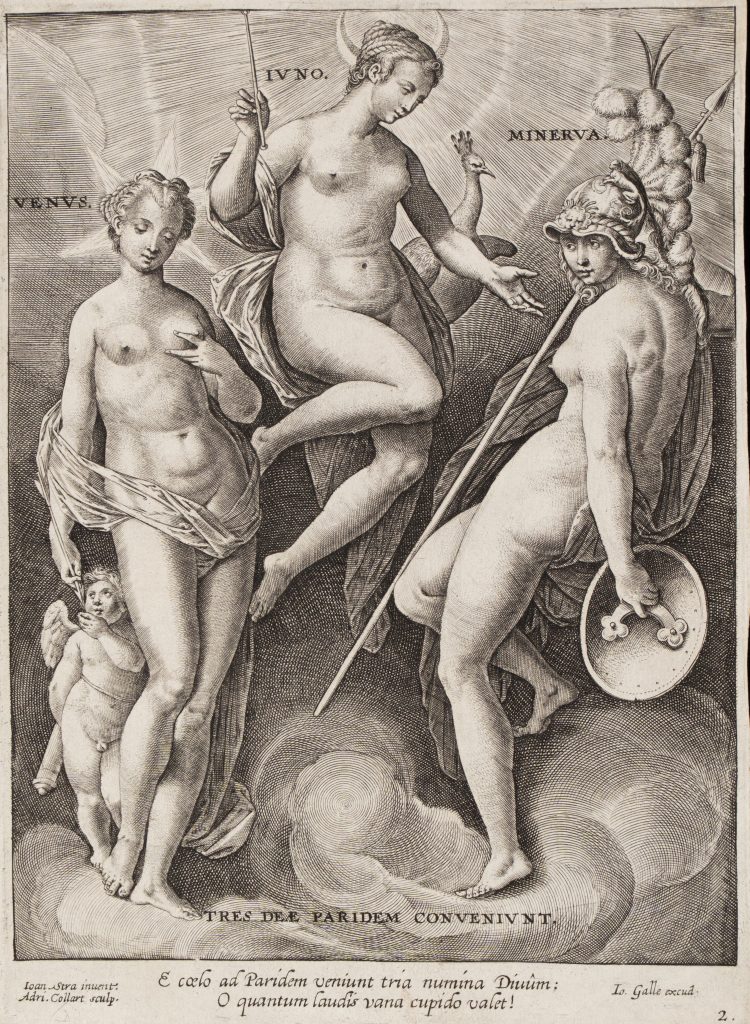
Johannes Stradanus, also known as Jan van der Straet, was a Flemish artist active for much of his career in Florence. His designs circulated widely through Antwerp print publishing, especially through the Galle family. This engraving, Tres Deae Paridem Conveniunt, was engraved by Adriaen Collaert after Stradanus’s 1587 drawing, now in the US National Gallery of Art (Click here), and was first published by Philip Galle in Antwerp in the same year. This impression is a later Joan Galle issue, with Io. Galle excud. at lower right.
The scene shows the three goddesses Venus, Juno, and Minerva gathered before the Judgment of Paris. Each goddess is identified by name and by her attributes: Venus appears with Cupid, Juno is accompanied by the peacock, and Minerva carries the helmet, spear, and shield of war and wisdom. The composition comes from the classical story in which the goddesses compete for the golden apple inscribed “for the fairest.” The myth begins with the wedding of Peleus and Thetis, the parents of Achilles. All the gods were invited except Eris, the goddess of discord. Angered by the slight, Eris threw the golden apple among the guests, causing Juno, Minerva, and Venus each to claim it. Jupiter refused to decide the contest himself and sent the matter to Paris, the Trojan prince. Paris awarded the apple to Venus after she promised him Helen, a choice that set in motion the events leading to the Trojan War.
The Latin inscription below the image gives the scene a moralising force: E coelo ad Paridem veniunt tria numina Divinum / O quantum laudis vana cupido valet! The lines may be translated: “From heaven the three divine powers come to Paris; oh, how great is the force of vain desire for praise.” The print therefore presents the myth not only as a classical episode, but also as a warning about vanity, desire, and judgment.
Within the collection, this print is closely connected with the other Stradanus works, including Nova Reperta (209), Americae Retectio (211), and the two impressions of the sea-monster plate from Venationes Ferarum, Avium, Piscium (434and 336). Together they show the range of Stradanus’s printed subjects, from classical mythology to maritime discovery, invention, navigation, and natural wonder.
Stradanus, Johannes (Jan van der Straet) (1523–1605)
Antwerp: Philip Galle, 1587
later state published by Joan Galle
Copperplate engraving
343
R1 Extremely rare - occasionally seen on the market