
Meerwunder und Seltzame Thier / Wie Die In Den Mitnacßtigen Landern Gefunden Werden
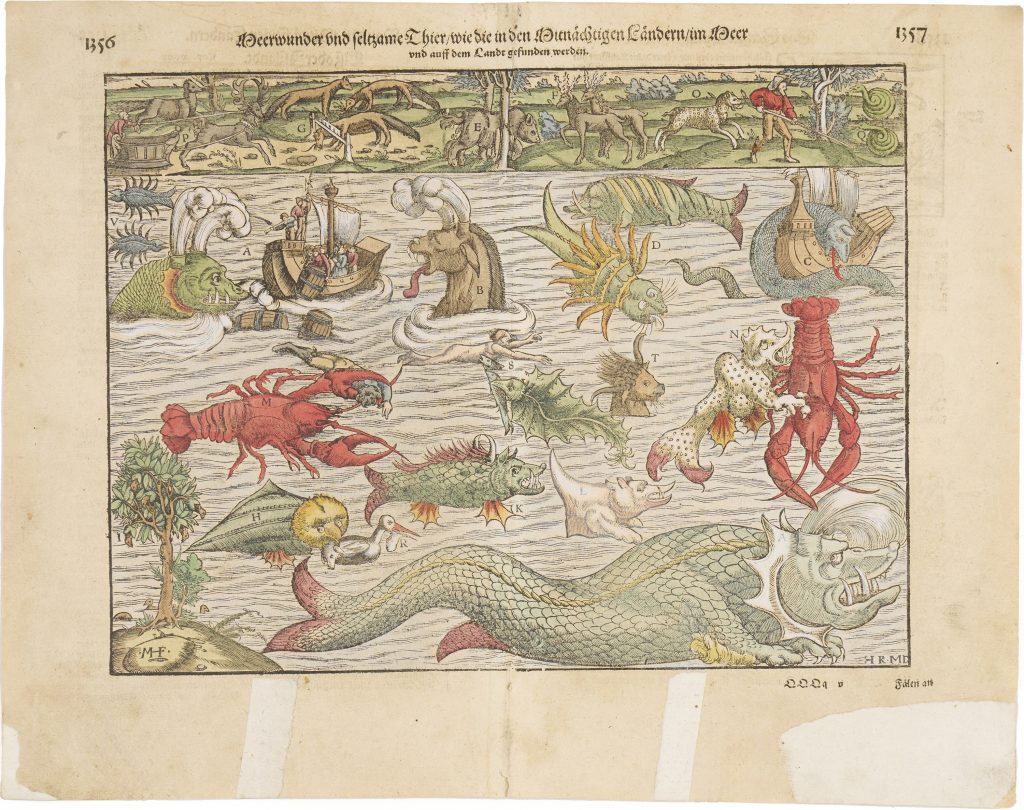
Sebastian Münster was a German humanist, Hebraist, cosmographer, and mapmaker based in Basel. His Cosmographia, first published in German in 1544 and substantially expanded in 1550, brought together geography, history, peoples, cities, animals, natural wonders, and maps. This woodcut belongs to the Cosmographia’s account of the northern regions and their strange animals and sea creatures.
Many of the sea creatures in the foreground derive from Olaus Magnus’s 1539 Carta marina et descriptio septentrionalium terrarum, one of the most influential sixteenth-century images of the northern seas. Münster’s woodcut adapts this world of whales, monsters, dangerous fish, and strange marine life for readers of the Cosmographia. The creatures are labelled with letters corresponding to explanatory text, turning the image into both a spectacle and a keyed natural-historical illustration.
The foreground presents the northern sea as dangerous and animate. In one scene, men aboard a vessel throw barrels into the water and sound trumpets to distract or calm a whale-like monster. Elsewhere, an enormous lobster grips a man in its claw. Above the sea creatures, terrestrial animals from northern regions appear, including reindeer, bears, leopards, and snakes. One figure appears to use a reindeer for transport, while another confronts snakes.
The image shows how Münster’s Cosmographia combined geography with marvel, danger, and natural history. The northern world is not presented only through coastlines and place names, but through animals, stories, warnings, and wonders. Within the collection, this print is closely connected with Münster’s De Prodigiis & ostentis (390) and the creation image (391).
Münster, Sebastian (1488–1552)
Cosmographia universalis, Basel: Heinrich Petri, 1550
1550, first
Woodcut
443
R3 Uncommon - dealers can usually obtain a copy