
De Prodigiis & ostentis
Sebastian Münster was a German humanist, Hebraist, cosmographer, and mapmaker based in Basel. His Cosmographia, first published in German in 1544, was a large illustrated description of the known world, combining geography, history, peoples, cities, natural wonders, animals, monsters, and maps. Münster died in 1552, but the work continued to be revised and reissued by the Petri publishing family in Basel.
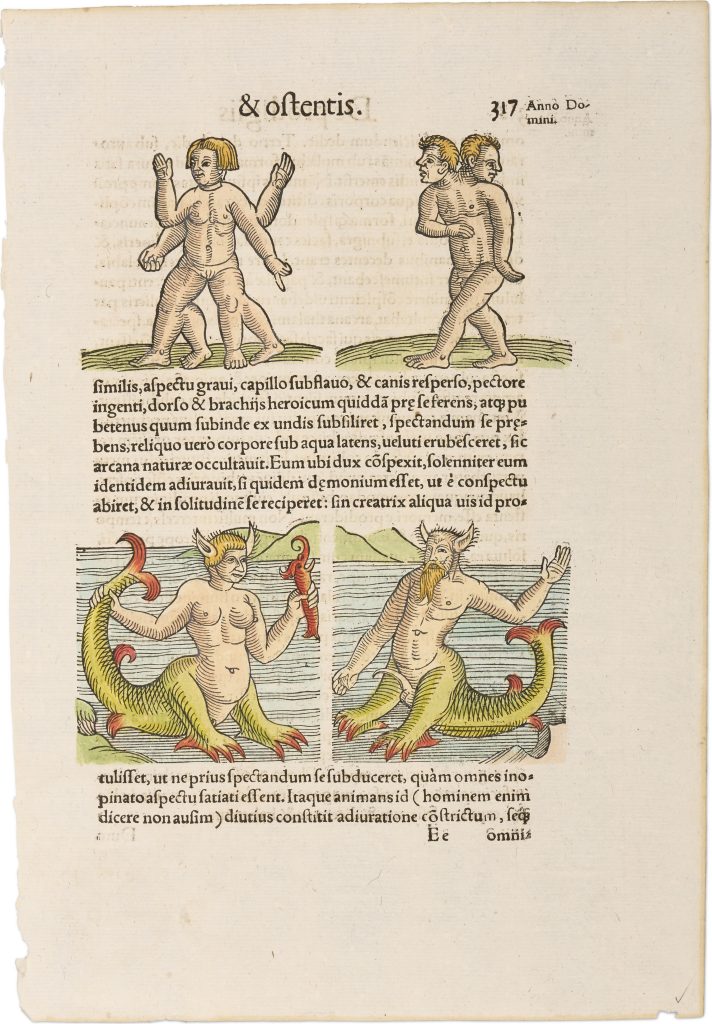
This page comes from the Cosmographia’s section on prodigies and portents. The woodcuts show conjoined human figures above and hybrid sea-creatures below, including mermaid- or triton-like beings with human upper bodies and fish-like tails. Such images belonged to early modern discussions of unusual births, monstrous forms, and strange beings said to appear in distant seas or lands.
In the sixteenth century, these figures were not presented simply as curiosities. They could be treated as signs, warnings, marvels of nature, or evidence of the variety of creation. Münster’s Cosmographia brought this material into the same world as maps, city views, animals, peoples, and histories, making the unusual and monstrous part of geographical knowledge.
Within the collection, this print is closely connected with Münster’s creation image (391) and his sea-creature print Meerwunder und Seltzame Thier (443). Together, these works show how the Cosmographia framed the world as a place of divine creation, natural abundance, danger, marvels, and moral interpretation.
Münster, Sebastian (1488–1552)
Cosmographia universalis, Basel: Heinrich Petri, 1550
1550, Latin edition
Woodcut
390