
Atlas minor sive totius orbis terrarum contracta delinea ex conatibus
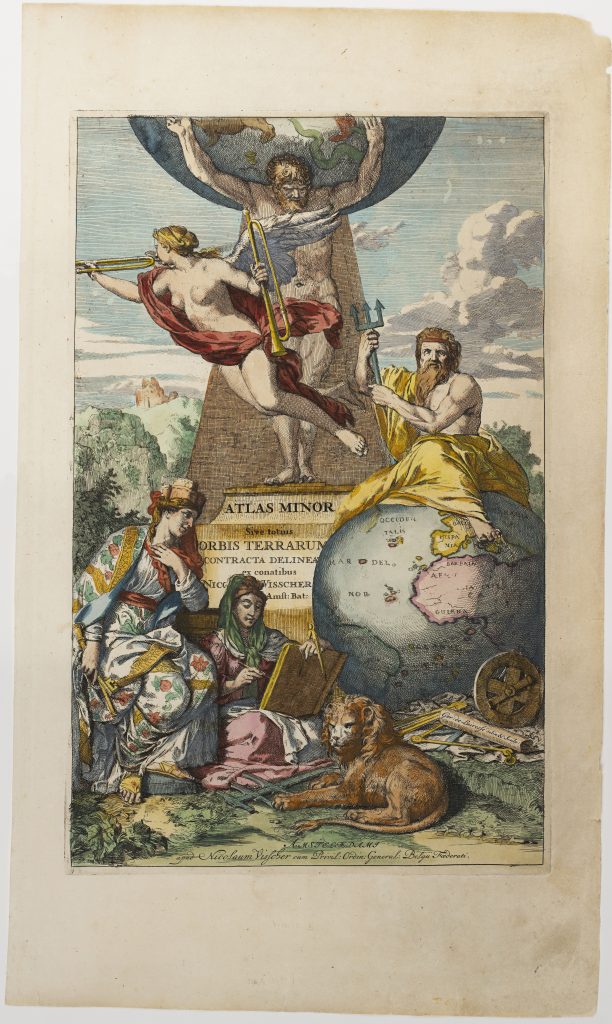
Nicolaes Visscher II was one of Amsterdam’s leading map publishing businesses after the death of his father, Nicolaes Visscher I, in 1679. Around 1683 he began issuing the Atlas minor sive totius Orbis Terrarum contracta delineatio ex conatibus a compact world atlas whose elaborate title page was designed and engraved by Gerard de Lairesse. This example belongs to the 1690 issue, while the title-page plate remained in use in later Visscher editions, including those overseen by Visscher’s widow.
The title page presents Visscher’s atlas through a learned allegory of geography, history, measurement, and maritime power. At the centre, Atlas supports the celestial sphere before a tall pyramid, linking the atlas to ancient learning, endurance, and cosmic order. To the right, Neptune sits astride a terrestrial globe and holds his trident, asserting the importance of the sea to global geography and Dutch commercial power.
On the left, Cybele, the personification of the Earth, wears a turreted crown and holds a key. Beside her, the Muse of History writes, suggesting that geography and history are mutually dependent forms of knowledge. Instruments of measurement, including a cross-staff, measuring chain, and circumferentor, lie nearby, grounding the allegory in practical surveying and mathematical geography. A lion at Cybele’s feet evokes the Dutch Republic and, more specifically, the heraldic language of Holland. Above the scene, Fame sounds twin trumpets, proclaiming the authority of the atlas and its publisher.
Lairesse, Gerard de (1641–1711)
Atlas minor sive totius orbis terrarum contracta delinea ex conatibus, Amsterdam: Nicolaes Visscher II, 1683
1690
Copperplate engraving
258