
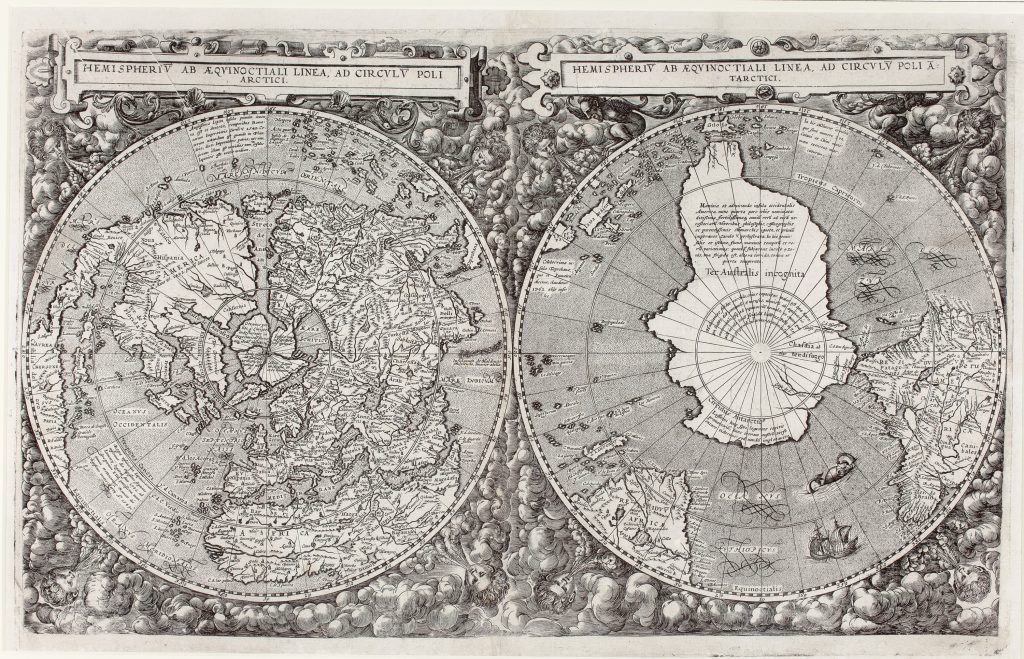
Hemispheriū ab aequinoctiali linea, ad circulū Poli Arctici: Hemispheriū ab aequinoctiali linea, ad circulū Poli Ātarctici
Cornelis de Jode was the son of the Antwerp mapmaker Gerard de Jode, whose Speculum orbis terrae was first published in 1578 as a rival to Abraham Ortelius’s Theatrum orbis terrarum (for the 1584 edition see 252). After Gerard’s death in 1591, Cornelis prepared the expanded 1593 edition of the Speculum, issued by Arnold Coninx. Although the atlas did not rival Ortelius commercially, it remains an important alternative expression of late sixteenth-century Antwerp cartography.
These twin hemispheric maps, one centred on the northern hemisphere and the other on the southern, were added to the 1593 edition. They are distinct from the maps in the 1578 edition and belong to Cornelis de Jode’s posthumous expansion of his father’s atlas. The 1593 edition is also typographically distinct from the 1578 edition, replacing Roman numeral pagination with Arabic numerals.
The projection is unusual for its time, presenting the world through polar hemispheres rather than the more familiar rectangular, oval, or double-hemisphere formats. The maps have been associated with Guillaume Postel’s lost 1581 wall map and with anonymous globe gores of about 1587. Their design shows the experimental quality of late sixteenth-century cosmography, where printed maps, wall maps, and globe-making traditions informed one another.
Jode, Cornelis de (1568–1600)
Speculum orbis terrae, Antwerp: Arnold Coninx, 1593
Separate publication. 1593, first
Copperplate engraving
112
R2 Very rare - one or two copies appear on the market