
Beschryving van Oud en Nieuw Oost-Indien
François Valentijn was a Dutch minister, author, and compiler who spent much of his career in the service of the Dutch East India Company. In 1685 he was sent to Ambon as a minister in the East Indies, where he remained for about a decade. After returning to the Netherlands, he went back to the Indies in 1705 and the following year served as army chaplain on an expedition to eastern Java. Ill health soon forced him to request permission to return to the Netherlands.
Back in Dordrecht, Valentijn completed his large compilation Oud en Nieuw Oost-Indien. Published between 1724 and 1726 in five parts and eight volumes, the work drew on Valentijn’s own journals, correspondence, and research, as well as material obtained from VOC officials and earlier written and printed sources. It was one of the most extensive printed accounts of the Dutch East Indies, combining geography, history, natural history, ethnography, maps, views, and commercial information.
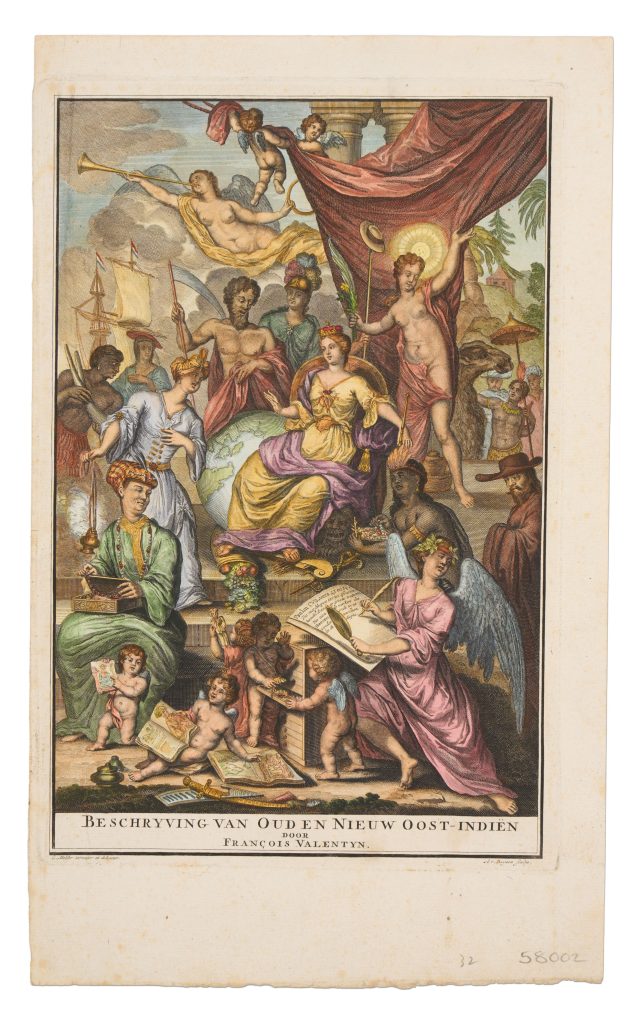
This title page presents Oud en Nieuw Oost-Indiën as an encyclopaedic account of Dutch activity in Asia and the wider overseas world. At the centre, a crowned female figure personifies the Dutch East India Company, identified by the VOC monogram on her chest. She is enthroned on a globe and accompanied by a lion, cornucopia, astrolabe, and Mercury’s caduceus, linking the Company with maritime navigation, commerce, abundance, and global authority.
Around her are personifications of the four continents, adapted from the established European allegory of the world’s parts bringing tribute. Asia, Africa, America, and Europe appear with attributes of dress, goods, and material culture, offering or displaying the commodities and knowledge gathered through Dutch trade. Ships at left refer to VOC maritime routes, while the scene revealed behind the curtain at right suggests overland trade in Asia. Fame sounds a trumpet above, proclaiming the achievements of the Company, while Truth opens the curtain and dispels obscurity.
The lower part of the image shifts from trade and empire to knowledge-making. Putti handle books, maps, drawings, shells, and a curiosity cabinet, referring to the maps, natural history, ethnographic descriptions, and collected information contained in Valentijn’s volumes. At lower right, a winged figure writes the biblical verse from Psalm 104:23–24, “Man goeth forth unto his work and to his labour until the evening. O Lord, how manifold are thy works! In wisdom hast thou made them all: the earth is full of thy riches.” This verse explains the frontispiece as an emblem: the riches of the world are presented both as commercial wealth gathered by the VOC and as the natural and geographical abundance described in the book.
François Valentijn, Oud en Nieuw Oost-Indiën, Dordrecht: Joannes van Braam; Amsterdam: Gerard onder de Linden, 1724–26
1724, first
Copperplate engraving
481
R3 Uncommon - dealers can usually obtain a copy