
Allegorie des Continents
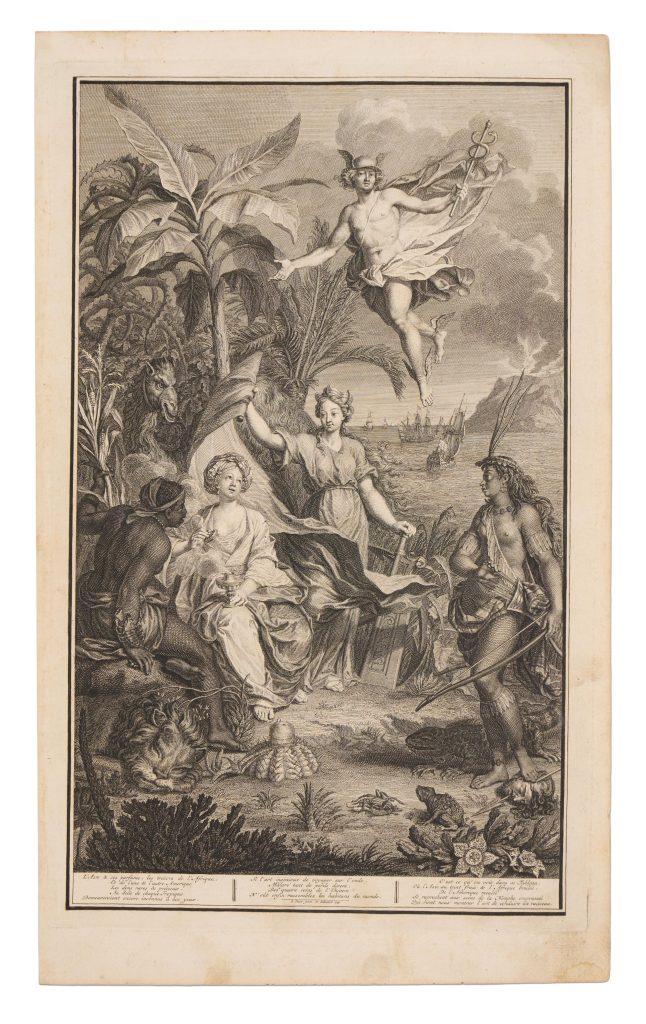
Zacharie Châtelain was a Huguenot publisher and compiler active in Amsterdam, now understood as the principal compiler of the Atlas historique, rather than the often-cited Henry Abraham Châtelain. Published over several years in the early eighteenth century, the Atlas historique joined geography, chronology, history, genealogy, commerce, religion, customs, and travel within an ambitious illustrated atlas. Volume V, first published in Amsterdam in 1719 by L’Honoré & Châtelain, was devoted principally to Asia and Asian trade. This title page was designed and engraved by Bernard Picart and is signed B. Picart invenit et delineavit 1719.
The title page presents Asia as a region opened to European knowledge through navigation, commerce, and travel. Asia sits at the centre of the composition, turbaned and richly dressed, holding a smoking censer that refers to perfumes, spices, and precious aromatics. A camel, her traditional animal attribute, appears in the wooded background. She is approached by the figure of Navigation, who holds a steering rudder and gestures toward the assembled continents, making the art of sea travel the means by which distant regions, peoples, and commodities are brought into contact.
Mercury flies above the scene, identifiable by his winged cap, winged ankles, and caduceus. As messenger of the gods and patron of travel, communication, and commerce, he reinforces the titlepage's central theme: the circulation of goods, knowledge, and people across the seas. In the distance, ships lie at anchor near a mountainous coast, linking the allegory to maritime exploration and trade. Africa sits beside Asia, shown as a dark-skinned female figure with a sleeping lion at her feet. Opposite her stands America, armed with a bow and arrows and wearing armlets, leg bands, a shoulder strap, and a feathered headdress. Her foot rests on a pierced severed head, and nearby are animals associated in European imagery with the New World, including an iguana, scorpion, and toad.
The French verses below the image explain the programme. They praise “Asia and her perfumes,” “the treasures of Africa,” and the rare and precious gifts of both Americas, declaring that these would have remained unknown without “the ingenious art of travelling over the waves.” The image therefore celebrates navigation as the art that gathers the inhabitants and riches of the world from the “four corners of the universe.”
Atlas historique, ou nouvelle introduction à l’histoire, à la chronologie & à la géographie ancienne & moderne, vol. 5. Amsterdam: L’Honoré & Châtelain, 1719
1719, first
Copperplate engraving
483
R3 Uncommon - dealers can usually obtain a copy