
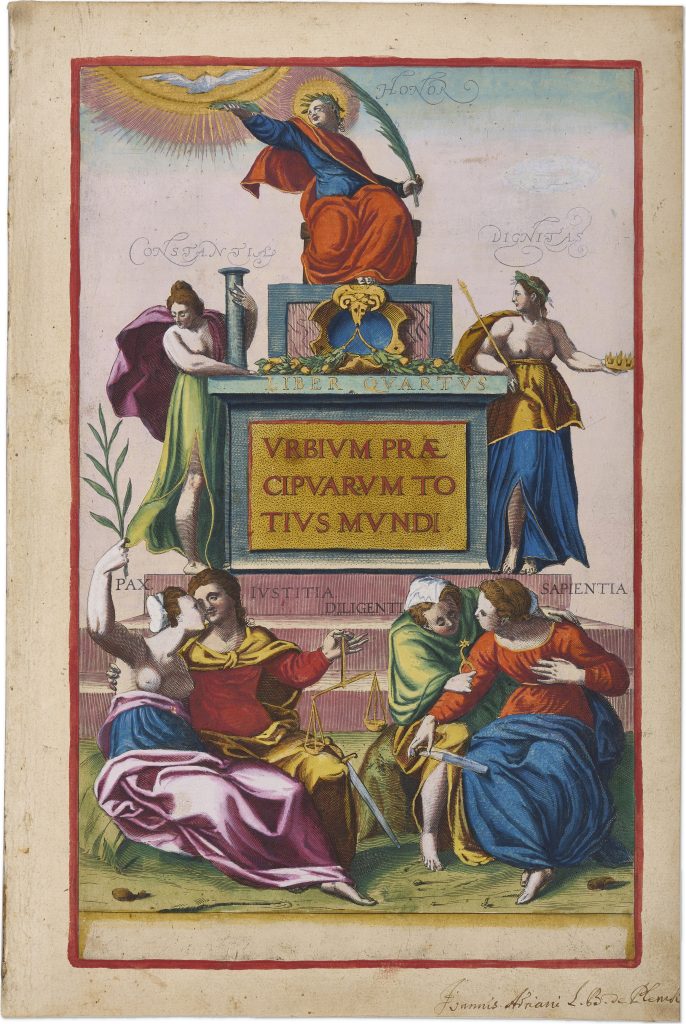
Urbium praecipuarum totius mundi
Georg Braun was a cleric, editor, and author from Cologne, best known as the principal editor of the Civitates orbis terrarum, the great six-volume atlas of city views. The first part was published in 1572, followed by successive parts in 1575, 1581, 1588, 1596, and 1617–1618. Frans Hogenberg, a Flemish engraver and publisher, supplied many of the engravings and was central to the visual form of the project. Together, Braun and Hogenberg created one of the most ambitious urban publications of the early modern period, presenting cities as political, commercial, religious, and social spaces, and combining topographical information with figures, costumes, heraldry, inscriptions, and civic symbolism. After Hogenberg’s death, the project was continued by his son Abraham in collaboration with the publisher Anton Hierat. The series was reprinted into the seventeenth century, often without significant revision, reflecting the continuing demand for printed urban imagery.
Although best known for its detailed city views, the Civitates is also notable for its allegorical title pages, which frame cities not merely as physical places, but as centres of government, religion, conflict, commerce, and civic identity. This title page introduces the fourth part of the Civitates, first published in 1588. It presents a group of personified virtues arranged around a stone architectural structure bearing the title. At the summit sits Honos, Honour, crowned and holding emblems of distinction and triumph. His placement above the title suggests that the cities gathered in the volume are to be understood not only as physical places but as expressions of civic reputation, achievement, and cultivated order.
At either side of the central structure stand Constantia and Dignitas. Constancy, leans against a column, a conventional emblem of firmness and endurance, while Dignity appears crowned and holding symbols of authority. Below them are further personifications of civic and moral order: Pax, Peace, with an olive branch; Justicia, Justice, with scales; Diligentia, Diligence, associated with purposeful labour; and Sapientia, Wisdom, with a book. Their arrangement creates a hierarchy of virtues through which the city is imagined as both governed and sustained. The title page therefore introduces the fourth volume not simply as a collection of urban images, but as a moralised theatre of civic life. Peace and justice provide the conditions for stability; diligence and wisdom support good government; constancy and dignity give civic order its authority; and honour crowns the whole. In the context of the Civitates, such imagery encourages the viewer to read city views as evidence of political culture, social discipline, and the ideals of urban civilisation.
Other title pages from the Civitates in this collection include 321, 153, and 400.
Braun, Georg (1541–1622) and Hogenberg, Frans (1535–1590)
Civitates orbis terrarum, book 4, Cologne: Petrus à Brachel, 1588
1588, first
Copperplate engraving
400