
L’Asie
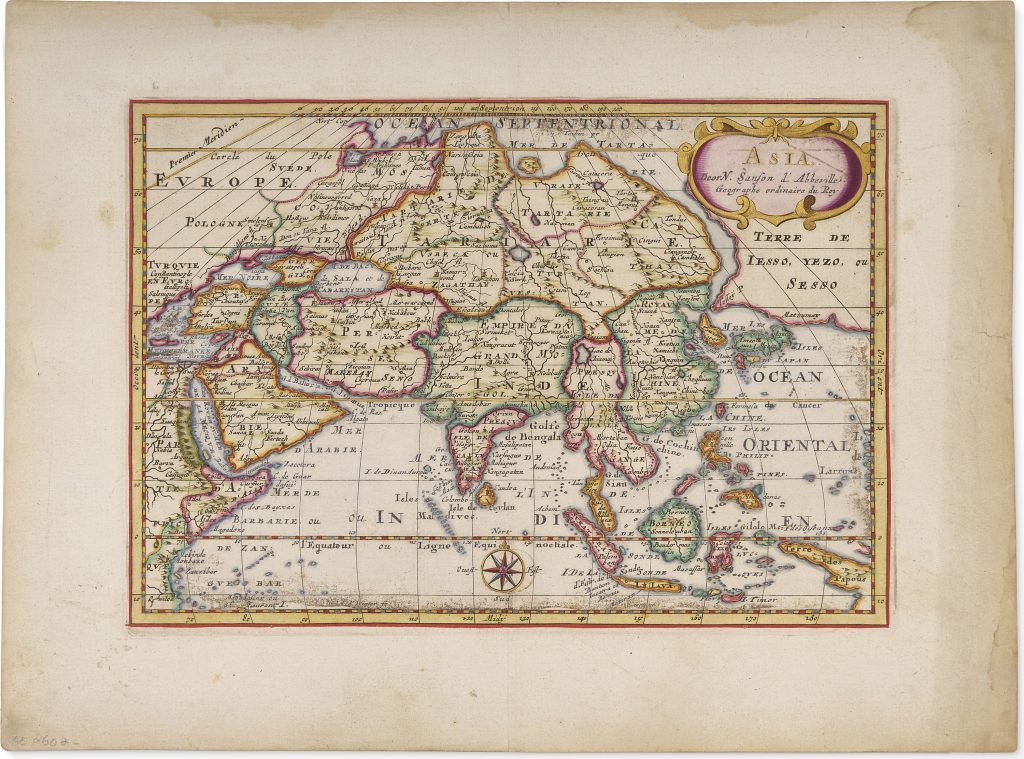
Nicolas Sanson was a French cartographer and royal geographer whose work helped establish a distinct French school of cartography in the mid-seventeenth century. Originally trained as a historian, he turned to mapmaking partly as a way of organising and illustrating historical and geographical knowledge. After his work attracted royal attention, he was appointed Géographe Ordinaire du Roi. His small-format continental atlases, including L’Asie en plusieurs cartes nouvelles et exactes, first published in Paris in 1652, presented Asia through a sequence of general and regional maps.
Among the seventeen maps featured in his atlas is this general map of Asia, which extends from the eastern Mediterranean and northeast Africa to Japan, Southeast Asia, New Guinea, and the northern edge of New Holland. It presents the continent through a dense network of kingdoms, regions, rivers, seas, and trading places, while also showing the limits of European knowledge around northern Asia, Japan, New Guinea, and the Pacific. The map is especially useful as the opening frame for Sanson’s more detailed Asian regional maps in the collection. Southeast Asia appears at lower right, with the Malay Peninsula, Sumatra, Java, Borneo, Celebes, the Moluccas, and New Guinea all positioned within the wider geography of Asia and the Indian and Pacific Oceans. North of Japan, the large landmass labelled Terre de Iesso, Yezo, ou Sesso reflects continuing uncertainty about the geography of the northwestern Pacific.
The rich hand colour and gold illumination attributed to Dirk Jansz. van Santen give this small-format map a visual presence beyond its original atlas scale.
Within the collection, this map is closely connected with Sanson’s related regional maps of the Sunda Islands (402), mainland Southeast Asia and the Malay Peninsula (403), and the Moluccas (404) which expand areas shown more generally here.
Sanson, Nicolas (1600–1667)
L'Asie en plusieurs cartes nouvelles et exactes..., Paris: Nicolas Sanson, 1652
1653-1660, Amsterdam
Copperplate engraving
401
R2 Very rare - one or two copies appear on the market