
Ignis
Adriaen Collaert was a Flemish engraver, draughtsman, and print publisher active in Antwerp in the late sixteenth and early seventeenth centuries. He worked within the Antwerp print culture associated with Philips Galle and the Plantin-Moretus press, producing religious, allegorical, natural-historical, and ornamental engravings for a learned European market.
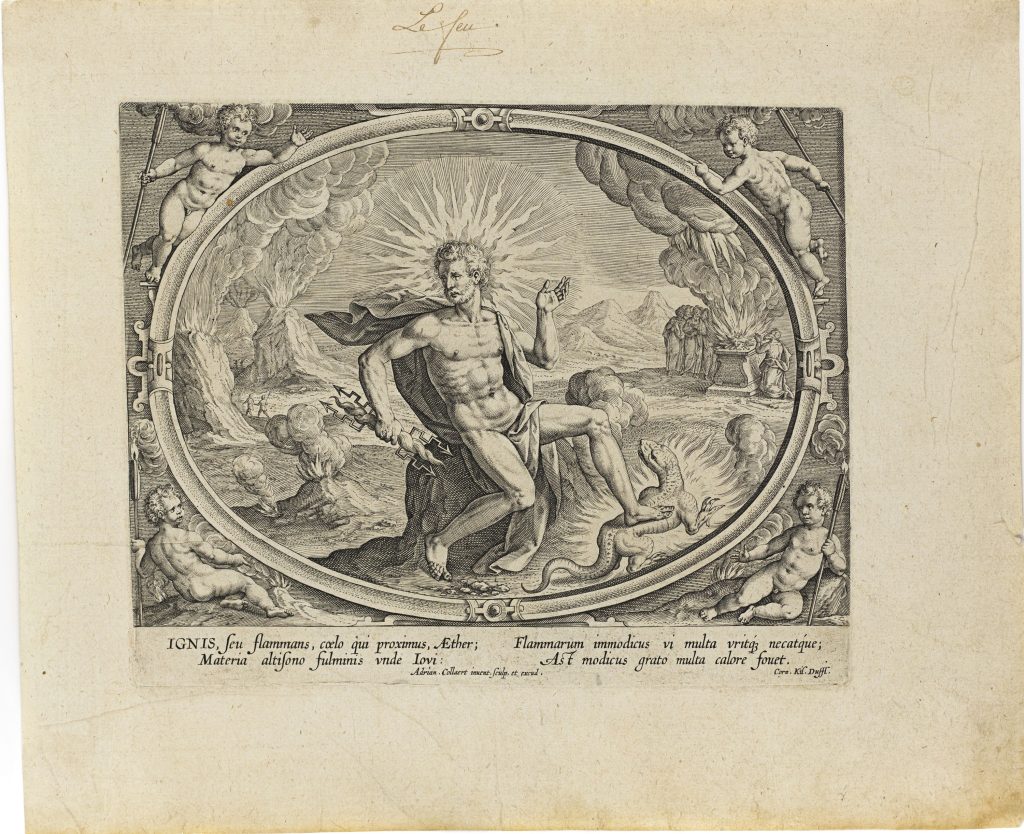
Classical and medieval natural philosophy held that all matter was composed of four elements: earth, water, fire, and air. Early modern artists often represented these elements as allegorical figures, accompanied by symbolic attributes, landscape settings, and related narrative scenes. Collaert’s Four Elements series presents semi-nude personifications set within oval frames, with putti in the spandrels echoing the attributes of the central figures. The Latin verses are by Cornelis Kiliaan, a corrector at Christopher Plantin’s publishing house in Antwerp and an important Dutch lexicographer. In this engraving, Ignis, or Fire, appears as a male figure surrounded by flames, holding thunderbolts and associated with Jupiter. A salamander rests beneath his foot, recalling the ancient and medieval belief that the creature could live in fire, a tradition Saint Augustine invoked in The City of God when discussing the endurance of bodies in the fires of hell. In the right middle ground, the engraving shows the Old Testament story of Elijah and the priests of Baal. According to 1 Kings 18, Elijah challenged the priests of Baal to call down fire upon a sacrificial offering; when they failed, Elijah drenched his own altar with water and prayed to the God of Israel. Fire then descended from heaven and consumed the sacrifice. Collaert shows this dramatic moment, with Elijah kneeling in prayer as divine fire falls onto the altar. The scene presents fire not only as destructive and volatile, but also as revelatory and divinely sanctioned.
Kiliaan’s Latin inscription presents fire as both destructive and beneficial: excessive fire burns and destroys, while moderated fire gives warmth and sustains life. IGNIS, seu flammans, caelo qui proximus, Aether; / Materia altisono fulminis unde Iovi: / Flammarum immodicus vi multa uritq[ue] necatque; / Ast modicus grato multa calore fovet. “Fire, or the blazing ether nearest to heaven, is the substance from which Jove’s thunderbolt is made. When excessive, it burns and destroys many things by the force of flames; but when moderate, it nurtures many things with pleasing heat.”
(“Fire, or the blazing Ether, near to heaven; whence [comes] to sublime Jove the substance of flame: beyond measure, by the power of flames, he burns and destroys many things; but with proper measure, he fosters many things with pleasing heat.”)
Collaert, Adriaen (1560–1618)
Separate publication
after 1587
Copperplate engraving
297