
Atlas Novus ad Usum Serenissimi Burgundiae Ducis
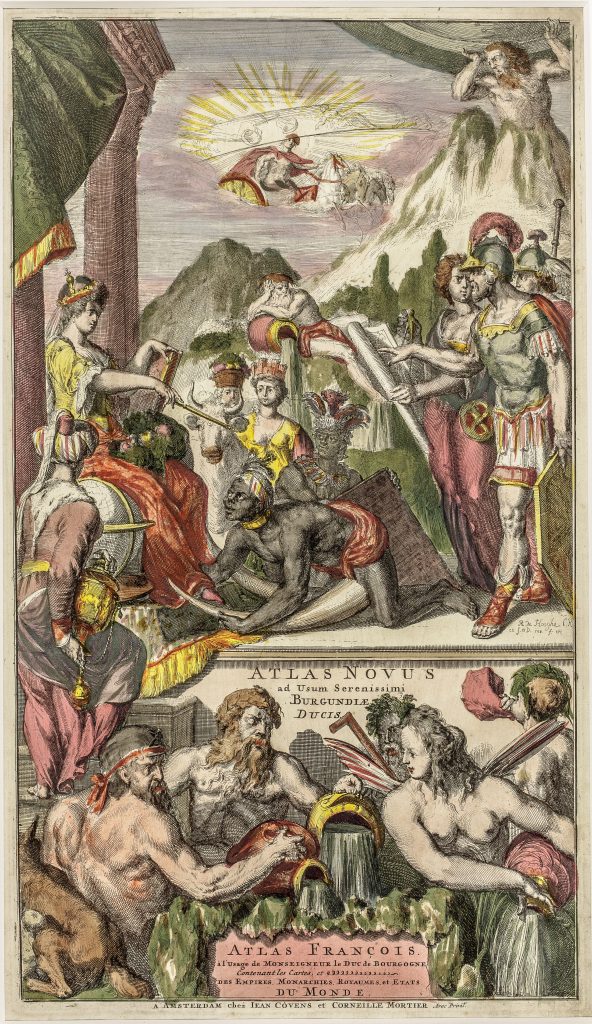
Romeyn de Hooghe was one of the most inventive Dutch designers and engravers of the late seventeenth century, known for complex allegorical compositions that linked politics, geography, warfare, and learned knowledge. This title page was engraved for the Amsterdam atlas publishing house of Covens & Mortier, which inherited and extended Pierre Mortier’s French-style atlas publishing programme. It appeared in the Atlas François under the Latin title Atlas Novus ad Usum Serenissimi Burgundiae Ducis.
The composition presents geography as a learned and imperial art. At the upper centre, personifications of the continents gather beneath a monumental architectural canopy. Europe is enthroned and receives tribute from Africa, Asia, and America, creating a visual hierarchy that places European knowledge and power at the centre of the world. Africa offers ivory, Asia appears with objects associated with trade and ritual, and America is shown with attributes of wealth and distant discovery.
Opposite this scene, the figure of Geography appears with scientific instruments, including dividers and an astrolabe-like device, and unrolls a plan before Mars, the god of war. The pairing suggests that measurement, mapping, and ordered knowledge can direct or discipline military power. Behind them, Atlas supports the heavens, while Apollo drives his chariot across the sky, linking terrestrial geography with celestial order and classical authority.
The lower part of the title page is occupied by river and sea deities who pour water from large vessels, symbolising the world’s waterways and maritime routes. The figure associated with Triton reinforces the oceanic dimension of the atlas, while the surrounding abundance of water, fruit, trade goods, and classical figures connects geography with fertility, commerce, and imperial reach. Ulla Ehrensvärd suggested that the seated figure beside the flowing waters represent Faunus, the Roman god of agriculture and animal husbandry, holding a polemoscope, an optical instrument associated with Johannes Hevelius in 1637. As a title page, the engraving frames the maps that follow as instruments of order, authority, and global knowledge.
Hooghe, Romeyn de (1645–1708)
Covens, Johannes, and Cornelis Mortier, Atlas François, Amsterdam: Covens & Mortier, 1720
1720, first
Copperplate engraving
156