
Germania Inferior id est XVII Provinciarum
Pieter van den Keere was a Flemish-born engraver, mapmaker, publisher, and globe maker who worked in both London and Amsterdam. He left Ghent around 1584 during the religious upheavals in the Low Countries and settled in London, where he trained as an engraver within the circle of his brother-in-law Jodocus Hondius I. His sister Colletta van den Keere married Hondius in 1587, linking Van den Keere to one of the most important Dutch mapmaking families of the period. By the 1590s, Van den Keere had moved to Amsterdam, where he worked as an independent engraver, map publisher, and atlas maker. His Amsterdam publications included small-format maps, regional atlases, and, in 1617–22, the Germania Inferior, an atlas of the Seventeen Provinces issued under his own name.
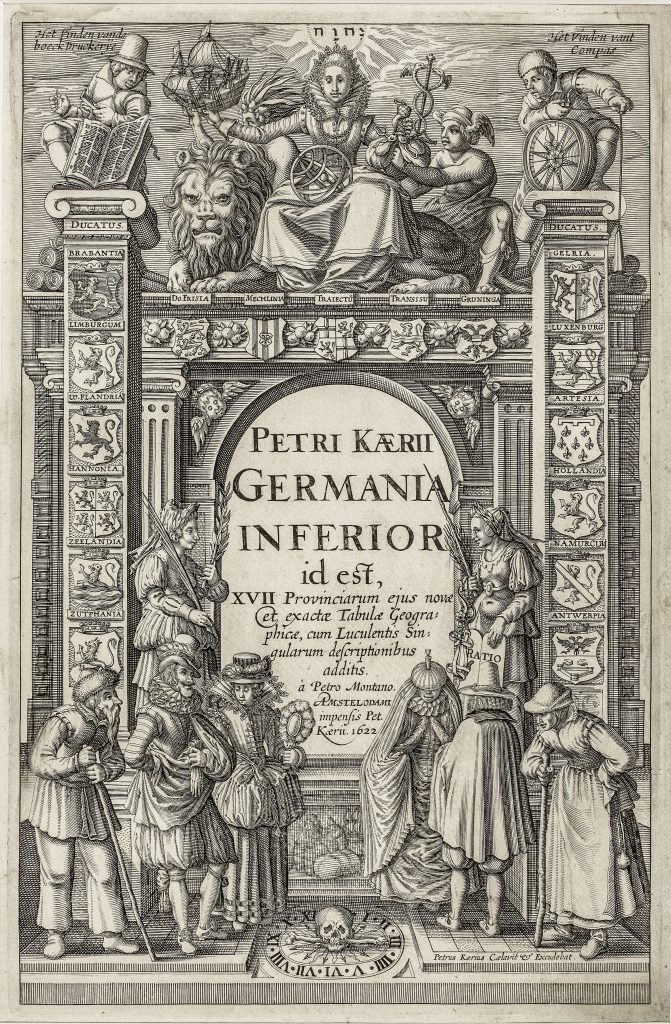
The title page presents the Low Countries through a dense allegorical and heraldic composition, reflecting the region’s political and commercial identity during the Twelve Years’ Truce between Spain and the Dutch Republic. At the top, a female personification of the Low Countries sits on the Leo Belgicus, the heraldic lion of the region. Above her appear the four Hebrew letters of God’s name. In her right hand she holds a sailing ship, symbolising Dutch maritime expertise, while with her left she shares a money bag with Mercury, the wing-helmeted god of commerce, who carries a caduceus. An armillary sphere rests in her lap, linking the image to geography, astronomy, and learned measurement.
The columns supporting the architectural frame bear the coats of arms of the Seventeen Provinces. At their summits, two sailors refer to major inventions associated with knowledge and navigation. On the left, one reads a book while holding a piece of chalk, symbolising the invention of printing (het vinden van de boekdrukkunst). On the right, another leans on a compass and holds a sounding line, representing the discovery of the compass (het vinden van het kompas).
Flanking the columns are female allegories: Peace, with an olive sprig and palm leaf, and Reason, labelled Ratio, holding a birch rod and shackles. At the base are six figures representing different social ranks: a noble couple, two merchants, and two peasants. The central panel shows a ship and two men near barrels and bales, suggesting trade negotiation. At the bottom is Van den Keere’s emblem: a skull and sundial, a vanitas reminder of life’s transience.
Keere, Pieter van den (1571–1646)
Germania Inferior id est XVII Provinciarum, Amsterdam: Pieter van den Keere, 1617
1622, second
Copperplate engraving
155