
Atlas Maritime
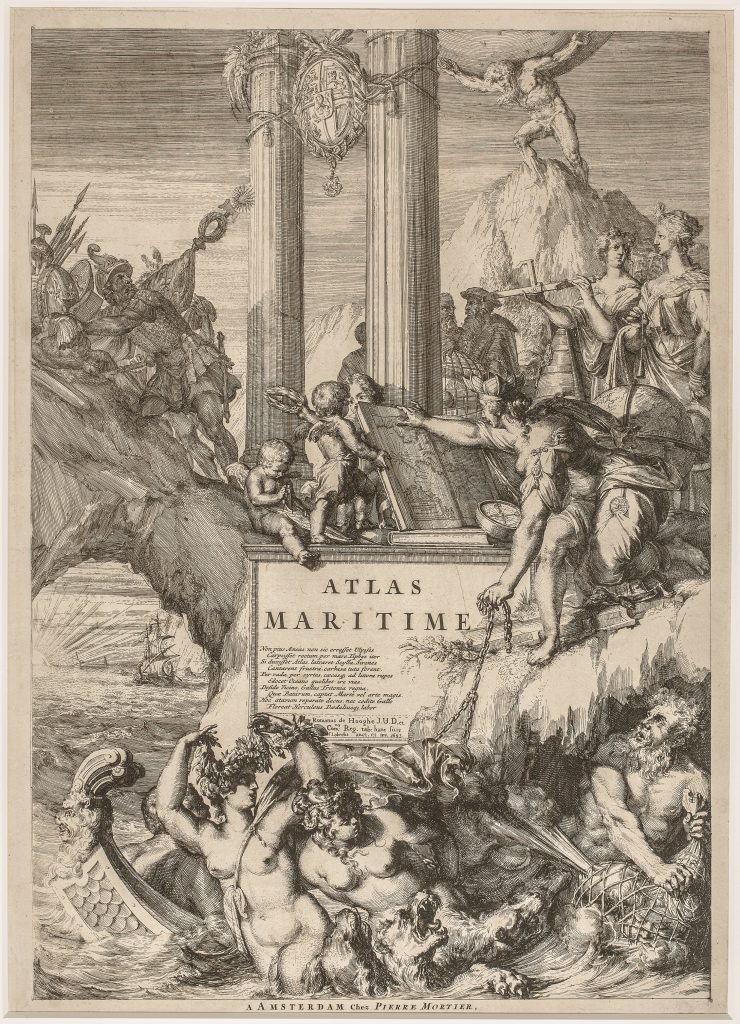
Pierre Mortier was an Amsterdam publisher who played an important role in bringing French cartography into the Dutch atlas market. After training in Paris in the early 1680s, he returned to Amsterdam and obtained privileges to publish French geographical works in the Dutch Republic. In 1693, Mortier published the Atlas Maritime in Amsterdam, including this engraved title page designed and engraved by Romeyn de Hooghe, one of the most inventive Dutch engravers of the late seventeenth century.
Mortier’s Atlas Maritime, formed part of the wider Neptune François publishing project, through which he issued French maritime charts for a Dutch and international market. The title page’s royal arms of William III, together with its imagery of navigation, astronomy, and naval command, connect the atlas to the Anglo-Dutch political world of William, who was King of England, Scotland, and Ireland as well as Stadholder of the Dutch Republic. The engraving therefore frames the atlas not only as a book of charts but also as a statement about maritime knowledge, naval power, and political authority. De Hooghe’s engraving presents navigation as both science and state power. At the centre, William’s royal arms are suspended between monumental columns, while above them Atlas supports the celestial globe. Behind the central figures stand allegorical figures of Astronomy and Navigation, and elderly sages consult an armillary sphere, linking nautical command to mathematical and astronomical knowledge.
The lower portion of the composition is animated by mythological and allegorical figures. Ten lines of Latin verse invoke the voyages of Aeneas, Ulysses, and the Argonauts, suggesting that their legendary journeys might have been safer had they possessed comparable navigational knowledge. The monsters Scylla and Charybdis, the Sirens, and the dangerous Syrtes off the African coast are evoked to stress the perils of navigation without proper guidance. In the foreground, a helmeted female figure, probably Britannia or a personification of naval power, points to a chart book while restraining the Sirens and sea monsters, aided by three putti. Snarling dogs in the foreground may allude to Scylla’s monstrous form. The image therefore does more than decorate the atlas: it claims that accurate charts, astronomical learning, and naval power can master the dangers that once threatened even the great sailors of antiquity.
Hooghe, Romeyn de (1645–1708)
Atlas Maritime, Amsterdam: Pierre Mortier, 1693
1693, first
Copperplate engraving
154
R2 Very rare - one or two copies appear on the market