
Scilam and Dondina, Maidegascar, Zanzibar, Scorsia, Inebila, Imangla and Java Minore
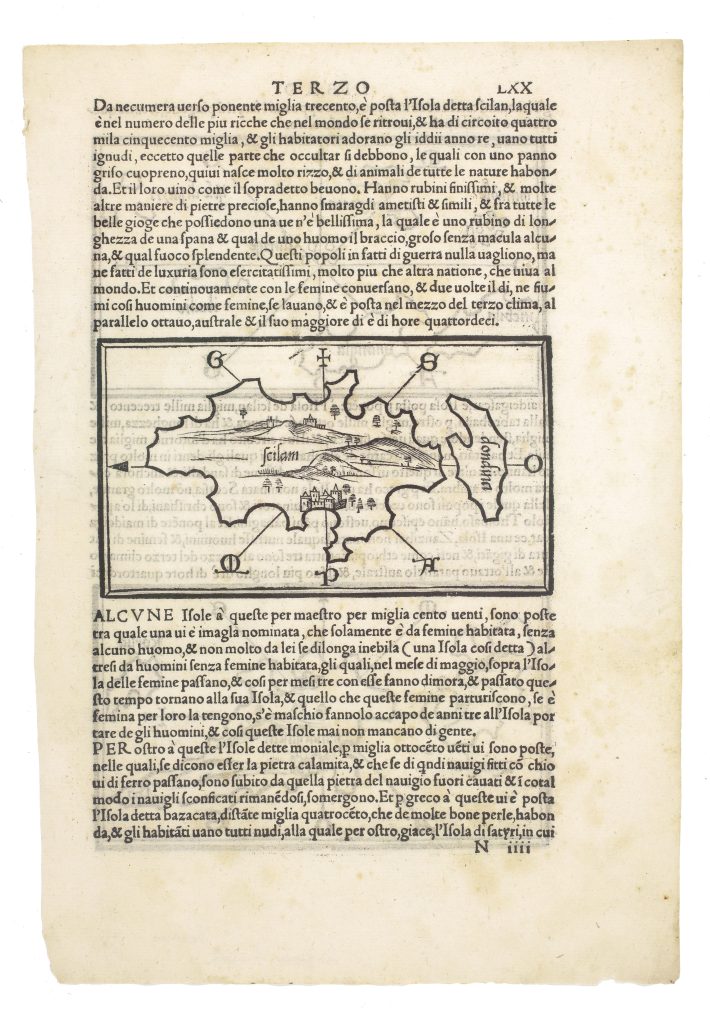
Benedetto Bordone, a Paduan-born miniaturist and illustrator active in Venice, is best known for his Libro nel qual si ragiona de tutte l’isole del mondo (Book of Islands), a landmark isolario first published in 1528. Drawing on classical geography, medieval travel narratives, and early exploration accounts, Bordone’s Libro catalogues 111 islands and peninsulas across the Atlantic, Mediterranean, and Indian Oceans. His maps, while schematic rather than navigational, reflect a transitional cartographic vision, combining compact, stylised layouts with speculative elements characteristic of the early modern geographical imagination.
These double-page maps, drawn from the third part of the Libro, depict the islands of Southeast Asia and the Indian Ocean. The first map features Scilam, often identified with Sumatra or, less commonly, Ceylon, and Dondina to its south. Thomas Suarez suggests Bordone may have adapted material from Mandeville’s Travels, particularly the account of a land where the dead were ritually consumed to prevent spiritual unrest. On the verso, Bordone introduces the fantastical paired islands of Imangla and Inebila—inhabited solely by women and men respectively, with boys transferred at the age of three. These appear alongside schematic representations of Maidegascar (Madagascar), Zanzibar, and Scorsia, probably Mauritius.
The accompanying map of Java Minore (Lesser Java) further demonstrates early European efforts to conceptualise Southeast Asia’s geography following the era of Portuguese maritime expansion.
Bordone, Benedetto (1460–1531)
Libro nel qual si ragiona de tutte l’isole del mondo, Venice: Nicolò d'Aristotile detto Zoppino, 1528
1528, first
Woodcut
13
R1 Extremely rare - occasionally seen on the market