
Novus et integra universi orbis descriptio
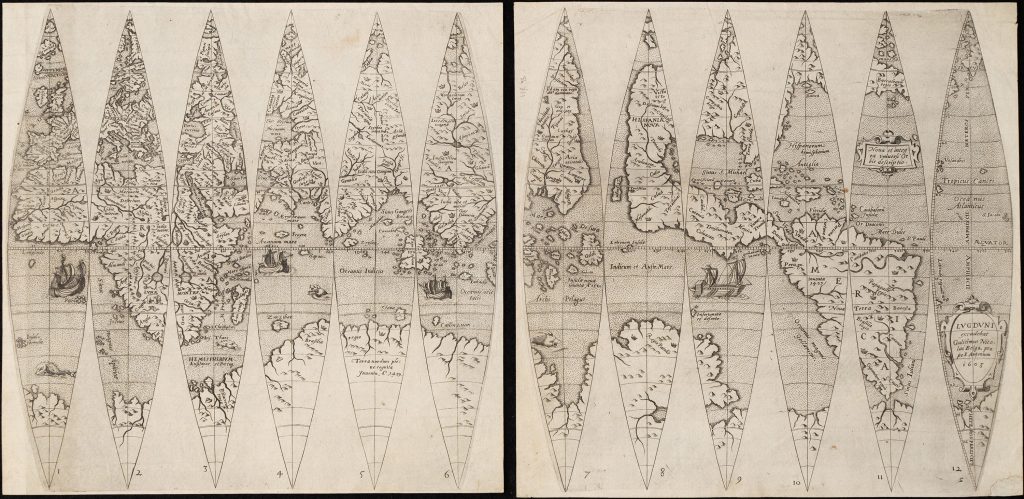
Gulielmus Nicolai was a Flemish-born engraver and publisher active in Lyon in the late sixteenth and early seventeenth centuries. This rare set of terrestrial globe gores was printed in Lyon in 1603. The two sheets together contain twelve engraved gores, six on each sheet, designed to be cut out and pasted onto a small globe of about 18.5 cm in diameter.
Although dated 1603, the gores preserve a much older view of the world. Their geography looks back to mid-sixteenth-century globe models associated with Caspar Vopell and François Demongenet, rather than to the more updated world maps of Abraham Ortelius, Gerard Mercator, or Giacomo Gastaldi. This is especially clear in the East Indies, where the islands are described as recently discovered in 1520, a strikingly archaic statement for a globe printed more than eighty years later.
That backward-looking geography is what makes the gores especially interesting. They show that early modern printed cartography did not always move smoothly from old information to new. Older cosmographical templates could continue to be copied, adapted, and sold, particularly in small globe form, where the object may have served teaching, display, or general geographical instruction rather than practical navigation.
Nicolai, Gulielmus (fl. 1573–1613)
Separate publication. Lyon: Gulielmus Nicolai, 1603
1603, first
Copperplate engraving
335
Only one other copy recorded, at Leiden University Library