
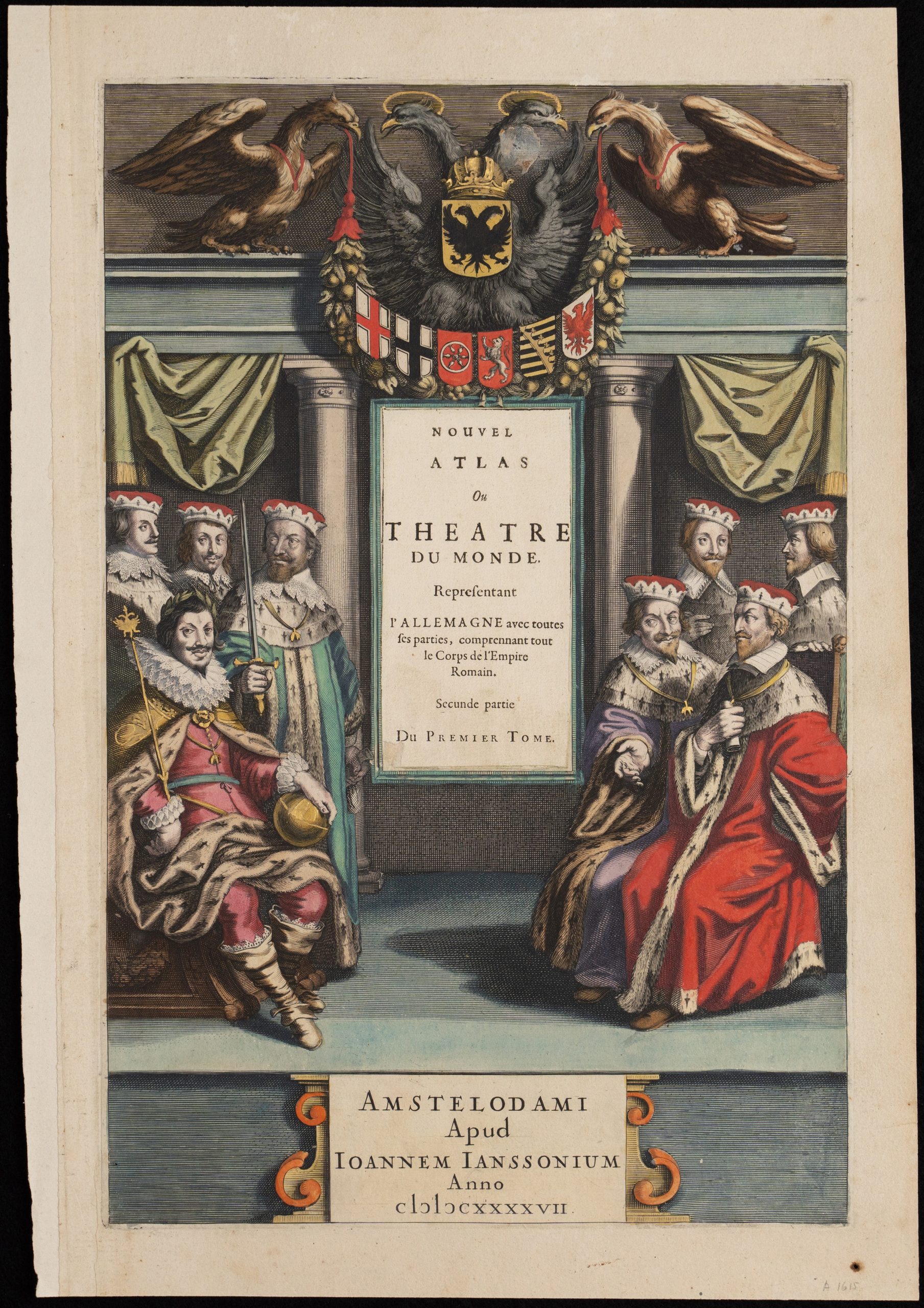
Nouvel Atlas ou Theatre du monde
Johannes Janssonius was born into a family of publishers and booksellers, gaining expertise in book printing from a young age.
In 1612, he married Elisabeth Hondius, the daughter of the renowned mapmaker Jodocus Hondius I (View Record (#80), View Record (#212), View Record (#253), View Record (#272)) and his wife, Colette (View Record (#113)).
Six years later, Janssonius established his own cartographic shop next door to his competitor, Willem Blaeu (View Record (#9), View Record (#76), View Record (#108), View Record (#121), View Record (#351), View Record (#358)).
In 1630, Janssonius partnered with his brother-in-law, Henricus Hondius (View Record (#18), View Record (#82), View Record (#114), View Record (#123), View Record (#126),
View Record (#378)) to release a supplement to the Mercator-Hondius Atlas titled ^Atlantis majoris
appendix, sive pars altera,which gradually expanded over the years.
In 1638, the atlas was renamedAtlas Novusand expanded to three volumes.
The following year, a French edition,Nouveau théâtre du Monde ou nouvel atlas^, was published.
The first volume was divided in to two parts, with the second part featuring maps of Germany.
The titlepage for this section is a richly symbolic depiction of the political structure of the Holy Roman Empire, which at the time nominally ruled over Germany.
Central to the design are seven Electors, each dressed in elaborate ermine cloaks and caps, signifying their status as the most influential rulers in the empire.
Their support was essential to the authority of the Holy Roman Emperor, Ferdinand III, who is portrayed seated on the left.
Ferdinand wears a laurel wreath as a crown and holds an orb and scepter, traditional symbols of imperial power.
Above the Electors, two eagles bear six heraldic shields, representing the coats of arms of the major principalities.
Between them, the Imperial Eagle dominates the composition, proudly displaying the emperor’s coat of arms on its chest, reinforcing Ferdinand III’s supremacy within the empire.
The title itself was printed on a separate rectangular sheet of paper and pasted onto the page—a common practice of the era, allowing for updates or regional variations in titles.
Janssonius, Johannes (1588–1664)
Nouveau theatre du monde ou nouvel atlas..., vol. 1, part 2, Amsterdam: Johannes Janssonius, 1639
1647
Copperplate engraving
319