
Charte universelle de tout le monde
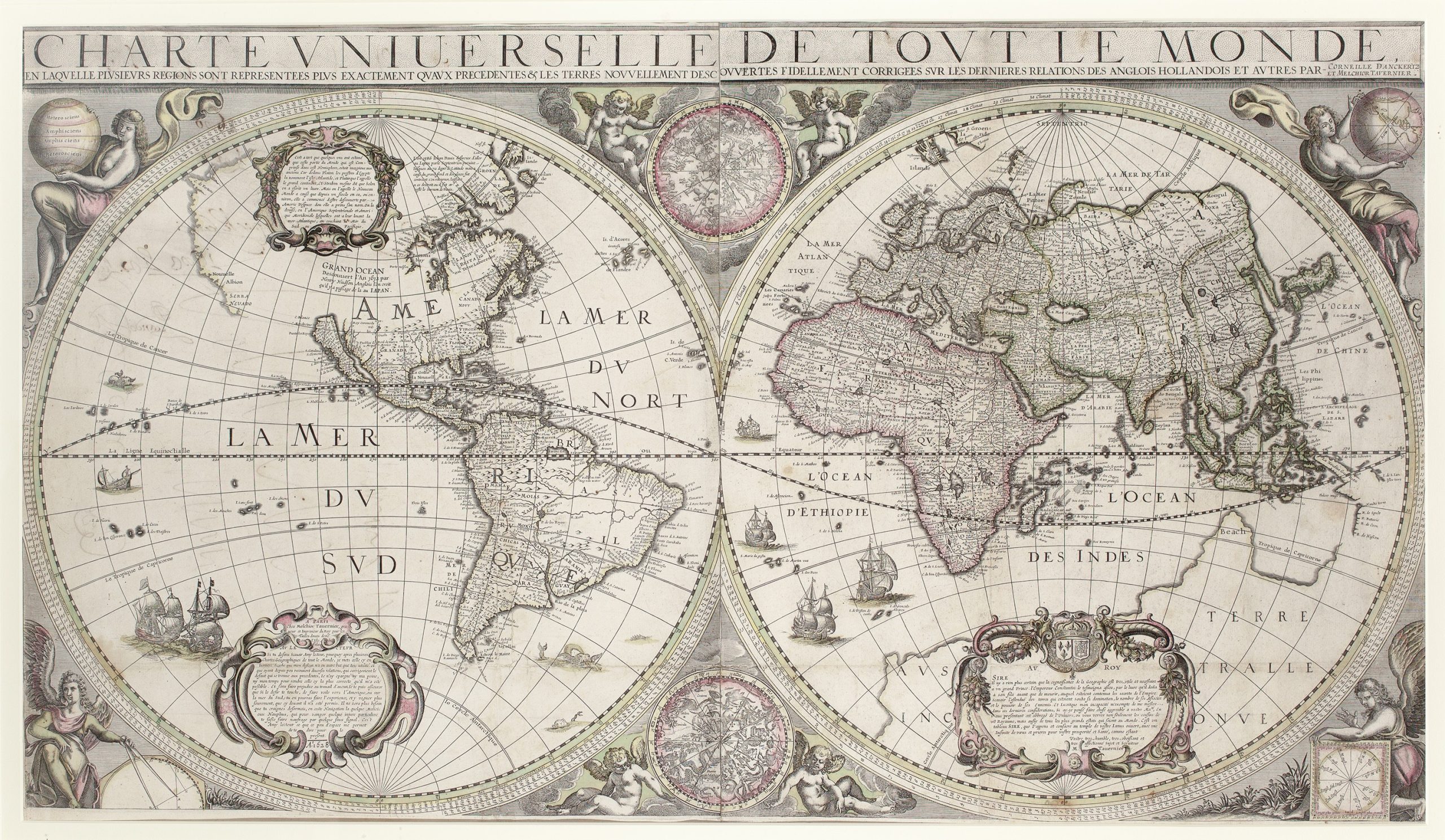
This elegantly engraved world map, printed on two sheets, the result of a collaboration between Amsterdam mapmaker Cornelis Danckerts and Paris-based printer Melchior Tavernier, who styled himself graveur et imprimeur du Roy (engraver and printer to the King).
Issued in 1628 and dedicated to the French monarch, the Charte universelle de tout le monde incorporates the latest European discoveries, particularly those by Dutch and English navigators, while retaining elements of classical geography and myth.
The map is presented in double-hemisphere format and is framed by richly decorative features: cherubic figures occupy the corner spandrels, while celestial hemispheres—flanked by angelic attendants—appear in the upper margin.
This ornamental scheme reflects the Baroque sensibility of early seventeenth-century French cartography, blending artistry with expanding empirical knowledge.
One of the most striking features is the depiction of California as an island, a misconception that persisted in European maps for much of the seventeenth century.
In the southern hemisphere, fragments of Terra Australis Incognita appear in the eastern hemisphere but are notably absent from the western—indicating the shifting status of this once-dominant cartographic hypothesis.
Significantly, the map incorporates early Dutch discoveries along the Cape York Peninsula in northern Australia.
Based on Jan Carstenszoon’s 1623
voyage, it records four rivers:
R. de Spult (Jardine River) R.
Batavie (Wenlock River) R. de Coen (Archer River) R. de Naßou (Nassau River) In addition, the map notes the Haulte Terre("High Land"), a term reflecting the elevated geographical features observed by Carstenszoon’s expedition.
These toponyms represent some of the earliest European attempts to systematically record the northern coastlines of Australia and are rare in maps of this period.
The Charte universelle de tout le monde stands as an important example of Franco-Dutch cartographic collaboration, combining aesthetic sophistication with emerging geographic detail.
It captures a transitional moment in world mapping—where myth and empiricism coexisted—and marks an important step in the gradual charting of the Australian continent.
Danckerts, Cornelis I (1603–1656)
Separately publication.
Paris: Melchoir Tavernier, 1628
1628, First
Copperplate engraving
86
R2 Very rare - one or two copies appear on the market