
Cosmographie in four bookes
Peter Heylyn was an English clergyman Royalist, and geographical writer whose work joined geography with history, politics, and theology. A supporter of Archbishop William Laud and an opponent of Puritan reform, Heylyn wrote religious and political tracts as well as geographical works. His Microcosmus: A little description of the great world, first published in 1621, was later enlarged into Cosmographie in four bookes, first published in 1652. The work became one of the major English geographical compilations of the seventeenth century, organising the world through chorography, history, politics, religion, and geographical description.
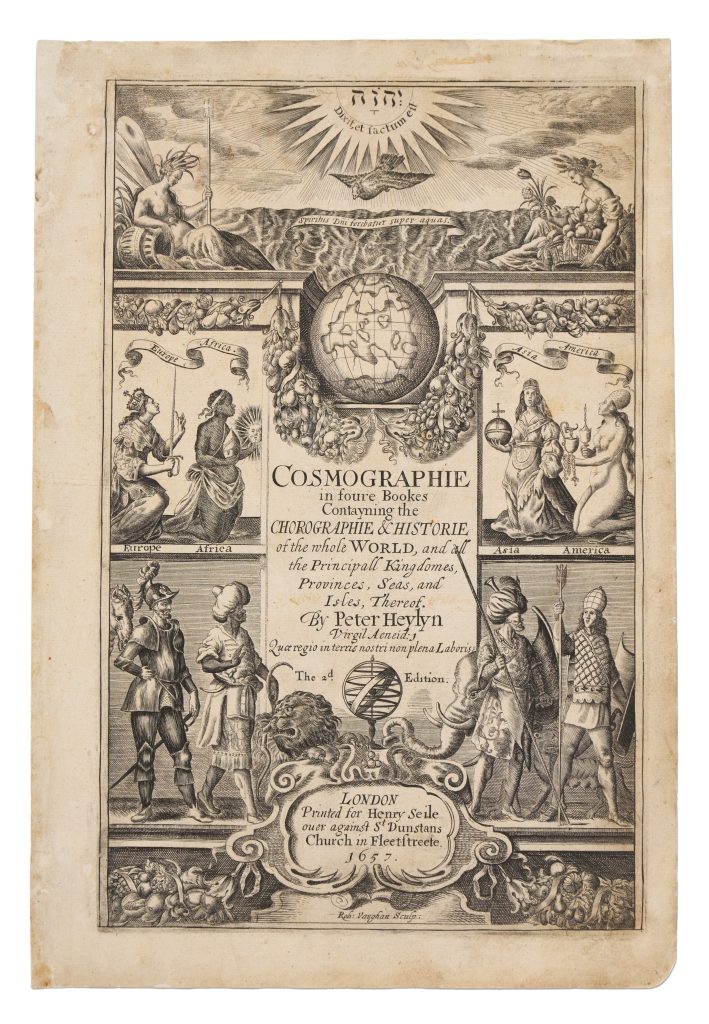
This engraved title page to the second edition of Cosmographie presents the world as both divinely created and geographically ordered. At the top, the radiant Hebrew name of God appears in a burst of light above the waters. The accompanying inscriptions refer to the act of Creation: Dixit, et factum est (“He spoke, and it was done”) and Spiritus Dni ferebatur super aquas (“the Spirit of the Lord moved upon the waters”). The dove of the Holy Spirit hovers beneath the divine name, reinforcing the theological framework of the image. On either side of the upper register are personifications of sea and earth, further linking the created world with the geographical subject of the book.
Below the Creation scene, a small terrestrial globe is set above the title panel, framed by hanging fruit and foliage. The side compartments present male and female personifications of the four continents. In the upper compartments, the continents appear as kneeling or seated female figures: Europe, at upper left, is crowned and holds an upright sword; Africa is partly draped and holds a radiant sun; Asia wears elaborate dress and holds an orb surmounted by a cross; and America is unclothed, wearing a small cap and holding vessels or precious objects.
The lower compartments show corresponding male figures associated with the same four continents. At lower left, Europe appears as an armoured soldier with a horse, while Africa is represented by a turbaned figure with a scimitar and a lion. At lower right, Asia appears with shield and spear beside an elephant, while America carries weapons and is accompanied by a wolf-like animal. Together, these figures point to the historical and political scope of Heylyn’s Cosmographie, which describes not only places, but also kingdoms, peoples, empires, warfare, and rule.
Just above the imprint cartouche, an armillary sphere appears beneath the title and the Virgilian motto from the Aeneid, 1.460: Quæ regio in terris nostri non plena laboris? (“What region of the earth is not full of our labour?”). The motto links the title page’s geographical scope with classical learning and with the human effort, conflict, travel, and history that fill the regions described in the book.
Last updated 4/6/2026 D:
Cosmographie in four bookes, London: Henry Seile, 1652
1657
Copperplate engraving
479
R3 Uncommon - dealers can usually obtain a copy