
De Reede van Batavia
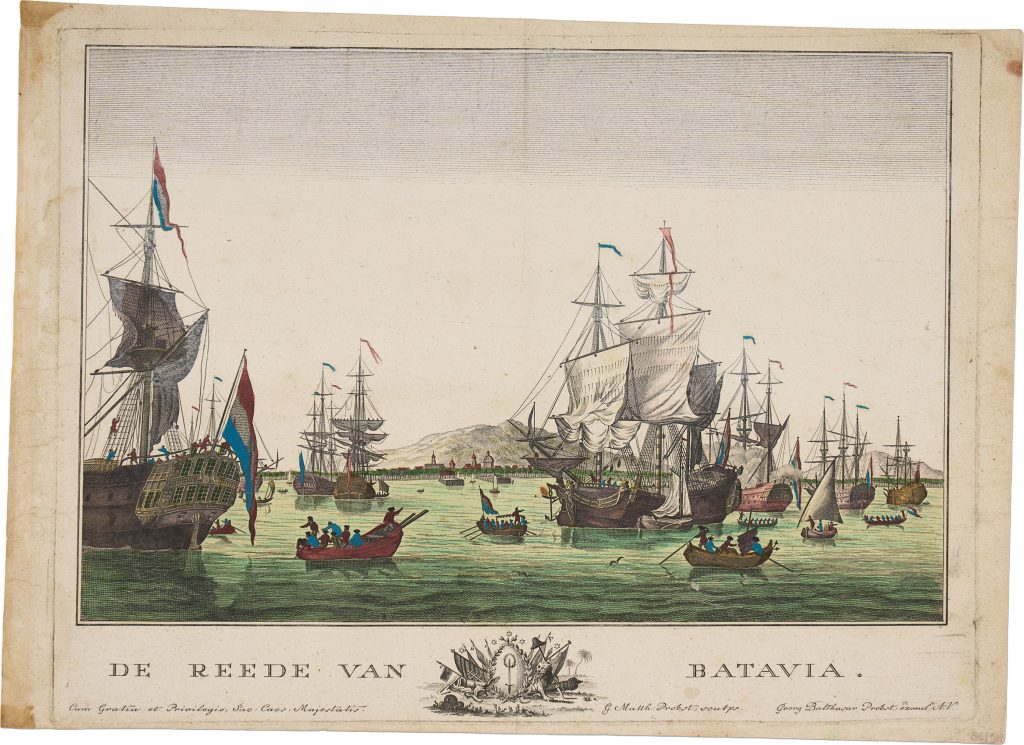
This hand-coloured engraving shows the roadstead of Batavia, the principal Dutch East India Company settlement in Southeast Asia. The plate was engraved by Georg Matthäus Probst and published by Georg Balthasar Probst in Augsburg around 1760. The image is said to be after a painting by Hendrik Kobell.
The title means “The Roads of Batavia, ” referring to the sheltered anchorage where East Indiamen and smaller vessels assembled to load and unload spices, textiles, porcelain, and other commodities. Founded by the Dutch in 1619 on the northwest coast of Java, Batavia became the administrative and commercial centre of the VOC’s Asian operations. Ships arriving from the Netherlands, the Cape of Good Hope, India, China, Japan, and the Indonesian archipelago passed through this anchorage, loading and unloading spices, textiles, porcelain, tea, timber, and other commodities.
Large Dutch merchant ships dominate the foreground, riding at anchor with their hulls, gunports, stern lanterns, rigging, and ensigns carefully shown. Smaller craft move between the ships and the shore, carrying people, provisions, and cargo. These boats are important to the scene: they show the roadstead as a working maritime space rather than a static harbour view.
In the middle distance, further ships fill the anchorage. Along the horizon are the low shoreline, buildings, warehouses, palm trees, and the fortifications of Kasteel Batavia, with distant volcanic forms rising behind them.
Probst, Georg Balthasar (1673–1748)
Augsburg: Georg Balthasar Probst, c. 1760
1760, first
Copperplate engraving
475
R3 Uncommon - dealers can usually obtain a copy