
Le Nouveau théâtre du monde, ou nouvel atlas
Johannes Janssonius was an Amsterdam publisher, bookseller, and mapmaker who became one of the leading figures in the continuation of the Mercator-Hondius atlas tradition. In 1612 he married Elisabeth Hondius, daughter of Jodocus Hondius I, and in 1630 he entered into partnership with his brother-in-law Henricus Hondius. Their Atlantis maioris appendix, sive pars altera of 1630 expanded the Mercator-Hondius atlas project and placed the firm in direct competition with the Blaeu publishing house.
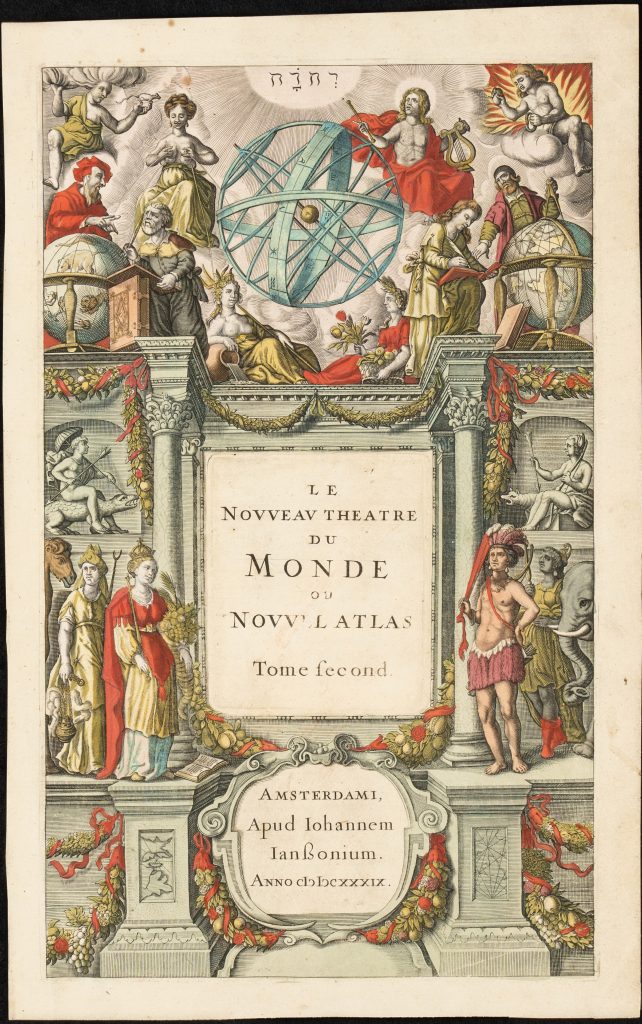
In 1638, the atlas was renamed Atlas Novus and expanded to three volumes. The following year, a French edition, Nouveau théâtre du monde, ou nouvel atlas, was published, featuring this title page in volume 2, inspired by Willem Blaeu's 1630 design (351). The title page is a striking example of symbolic artistry. At its centre stands a grand architectural structure, illuminated by divine light emanating from the four Hebrew letters of God’s name. This edifice is supported by two ornate Corinthian columns and adorned with allegorical figures representing various aspects of knowledge and the cosmos. Crowning the composition is a large armillary sphere, symbolising the cosmic harmony governing celestial movements, complete with the ecliptic and zodiac signs. Flanking the sphere are Apollo, the god of the Sun, holding his lyre and sceptre, and Juno, whose milk was said to form the Milky Way. Surrounding them are personifications of the four elements: at the top, Air (holding a chameleon) and Fire (holding a rock and flint); below the sphere, Earth (depicted with fruit and flowers) and Water (with a pouring urn and a two-pronged fork).
Beside Earth and Water are two scholars —masters of astronomy and geography—engaged in instruction. One demonstrates the workings of a celestial globe to a scribe, symbolising the diligent recording of knowledge for posterity. The other scholar uses a terrestrial globe and dividers to instruct a female student, who attentively records her learnings. Together, the scribe and the student embody the transmission of knowledge. The composition is framed by four female personifications of the continents, each bearing the wealth and attributes of their lands. Europe, on the right, is crowned and fully clothed, holding a sceptre. A cornucopia in her hand symbolises fertility, while an open book at her feet represents knowledge. Behind her is Asia, draped in silks and jewels, holding incense and a staff topped with a crescent moon, reflecting spirituality and trade. A camel behind her represents the trade routes traversing the continent. On the left are America and Africa, depicted in a semi-clothed states to reflect contemporary European perceptions of their “cultural simplicity.” America is barefoot, wearing a feather skirt and headdress, and equipped with a bow, arrows, and club, symbolising her connection to nature. Africa, wears a short tunic, holds a staff and balsam, and stands beside an elephant, an emblem of the ivory trade.
In the upper niches of the structure, two figures represent Spanish South America: Peru and Mexico. One is seated on a caiman, holding a parasol and bow, while the other sits beside a wild animal, armed with bow and arrows. Together this title page emphasises the atlas’s ambition to encompass knowledge of the entire cosmos and the world.
Janssonius, Johannes (1588–1664)
Le Nouveau théâtre du monde ou, nouvel atlas, vol. 2, Amsterdam: Johannes Janssonius, 1639
1639, first
Copperplate engraving
303