
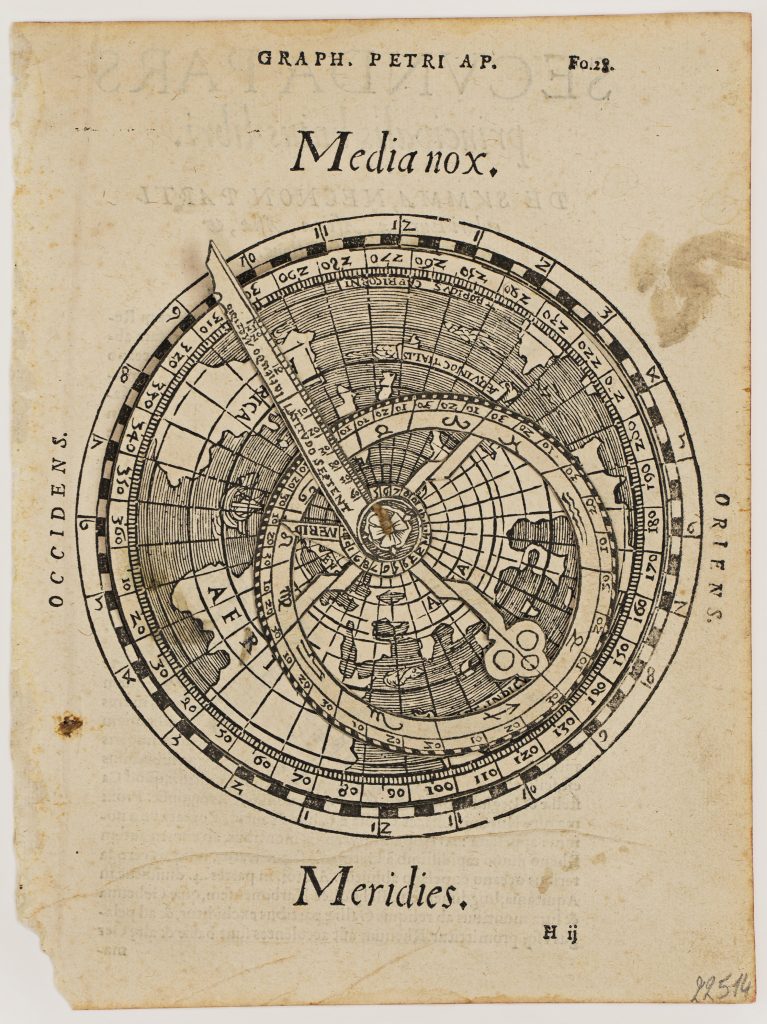
Speculum cosmographicum
Peter Apian was a German mathematician, astronomer, mapmaker, and professor of mathematics at the University of Ingolstadt. His Cosmographicus liber, first published at Landshut in 1524, became one of the most widely used introductions to cosmography in sixteenth-century Europe.
This printed page from the 1545 Latin edition of Cosmographia features the Speculum cosmographicum, a or “cosmographical mirror, ” a movable volvelle designed for astronomical and geographical calculation. The instrument combines printed scales, rotating paper components, and a small polar-projection world map, allowing the reader to use the book as a practical calculating device. The volvelle consists of a printed base with degree and hour scales, overlaid by a rotating disc carrying the world map. Above this sits a further revolving component with a zodiacal band and marked stars, completed by an index arm scaled for latitude. Together, these parts enabled readers to explore relationships between place, time, celestial motion, and terrestrial position.
The device reflects the practical character of Renaissance cosmography. Apian’s work did not treat geography, astronomy, and mathematics as separate fields, but as interconnected ways of understanding the earth in relation to the heavens. The Speculum cosmographicum therefore turns the printed book into a working instrument, combining text, image, and movement in the service of instruction. In 1529, Apian’s student Gemma Frisius revised and expanded the work under the title Cosmographia. Described as diligenter recognita (“diligently corrected”), Frisius’s edition updated the scientific content and gave greater attention to practical instruments, including the astrolabe, cross-staff, and volvelles. A further expanded edition appeared in 1533, incorporating Frisius’s own writings and additional instructional material. Through later Latin and vernacular editions, Cosmographia became a standard introduction to world measurement and the use of cosmographical instruments.
The 1545 Antwerp edition, published by Gregorio Bontio and printed by Aegidius Diesthemij, exemplifies the maturity of the text’s form and function. It helped to solidify Cosmographia’s influence across early modern Europe, resulting in over thirty editions and translations into Latin, French, Spanish, and Flemish. The Speculum cosmographicum remains one of the most visually and conceptually advanced instruments of its kind, offering insight into the dynamic interplay between bookmaking, science, and visual learning in the sixteenth century.
Apian, Peter (1495–1552)
Cosmographicus liber, Landshut: Johann Weyssenburger, 1524
1545, Latin edition
Woodcut
230
R2 Very rare - one or two copies appear on the market