
Macrobii Ambrosii Aurelii Theodosii Commentarii in Somnium Scipionis et Saturnalia
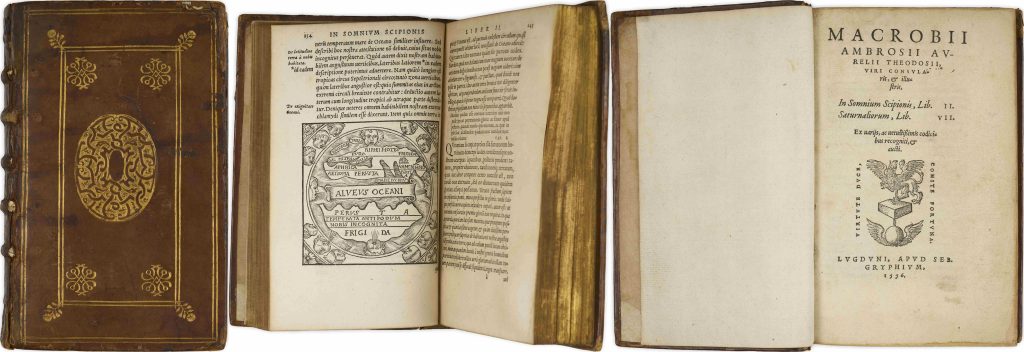
Ambrosius Theodosius Macrobius was a late Roman writer whose works helped preserve ancient ideas about the heavens, the earth, and humanity’s place within the universe. His fifth-century commentary on Cicero’s Dream of Scipio was especially important for geography because it explained the earth through climatic zones, including a northern temperate zone, a central torrid zone, and a southern temperate zone beyond the equator. This way of imagining the earth helped medieval and early modern readers think about unknown southern regions long before those places were mapped by European navigators.
Macrobius’s works circulated in manuscript during the Middle Ages and entered print in the fifteenth century. This Lyon edition, printed by Sebastian Gryphius in 1556, brings together two works: Commentarii in Somnium Scipionis and Saturnalia. The Commentarii explains Cicero’s Dream of Scipio, a passage from De re publica, in which Scipio Aemilianus dreams of viewing the universe from above and hearing about the order of the heavens, the earth, virtue, and the soul. Saturnalia is a separate work: a collection of learned dialogues on Roman religion, literature, antiquarian knowledge, and classical authors.
The edition includes woodcut diagrams and cosmographical figures connected with Macrobius’s discussion of the heavens and earth. The world map is a schematic image of the earth’s zones. Its importance lies in the way it gave visual form to an inherited classical idea: that the known northern world might be balanced by a southern region that people could imagine but not yet reach or map.
Macrobius, Ambrosius Theodosius (fl. c. 400)
Somnium Scipionis, lib. II. Saturnaliorum, lib. VII. Ex variis, ac vetustissimis codicibus recogniti, & aucti, Venice: Nicolaus Jenson, 1472
1556, Lyon: Sebastian Gryphius
Letterpress with woodcut map/diagrams
210
R3 Uncommon - dealers can usually obtain a copy