
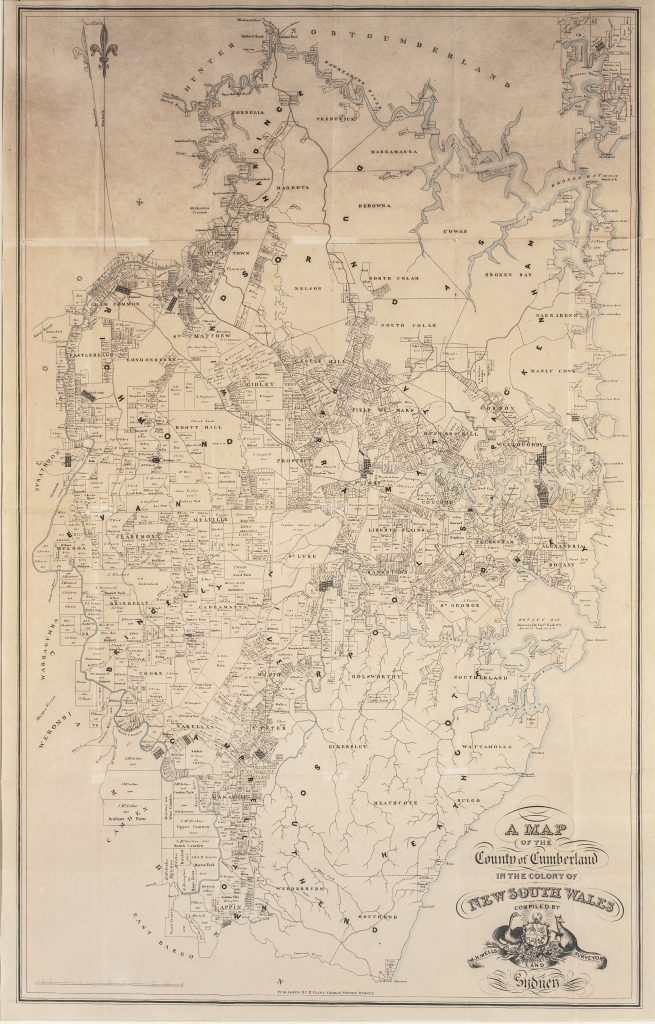
A map of the County of Cumberland in the Colony of New South Wales
William Henry Wells was an English-born surveyor, publisher, and lithographer active in Sydney during the early colonial period. Arriving in New South Wales in the 1830s, he established himself as one of the colony’s leading commercial map publishers, producing plans, town maps, directories, and cadastral surveys. His maps helped document the rapid growth of Sydney and the surrounding districts during a period of expanding European settlement.
Published in Sydney in 1840, this large cadastral map depicts the County of Cumberland, the administrative county encompassing Sydney, Parramatta, Liverpool, Windsor, and the surrounding settled districts of New South Wales. The map records land grants, parish boundaries, roads, settlements, rivers, and major topographical features, providing a detailed picture of colonial land occupation in the decades after British settlement.
Cumberland County contained most of what later became the Sydney metropolitan area, extending from Broken Bay in the north toward the Illawarra escarpment in the south. It was the first county named in New South Wales, its name chosen by Governor Arthur Phillip in June 1788 in honour of Prince Henry, Duke of Cumberland. By the 1830s, the county had been divided into parishes as part of the British-derived system of land administration used in the colony.
Wells’s map captures the region before the major suburban expansion of the later nineteenth century. Areas now absorbed into Sydney appear as farms, estates, commons, villages, roads, and waterways. The map shows the relationship between Sydney, Parramatta, Liverpool, Windsor, Botany Bay, Broken Bay, and the Hawkesbury-Nepean river system, illustrating the cadastral framework on which colonial settlement and land ownership were organised.
Wells, William Henry (c.1817–1860)
Sydney: William Baker, 1840
1840, first
Copperplate engraving
164
R2 Very rare - one or two copies appear on the market