
Nova orbis terrarum delineatio singulari ratione accommodata meridiano Tabb. Rudolphi Astronomicarum
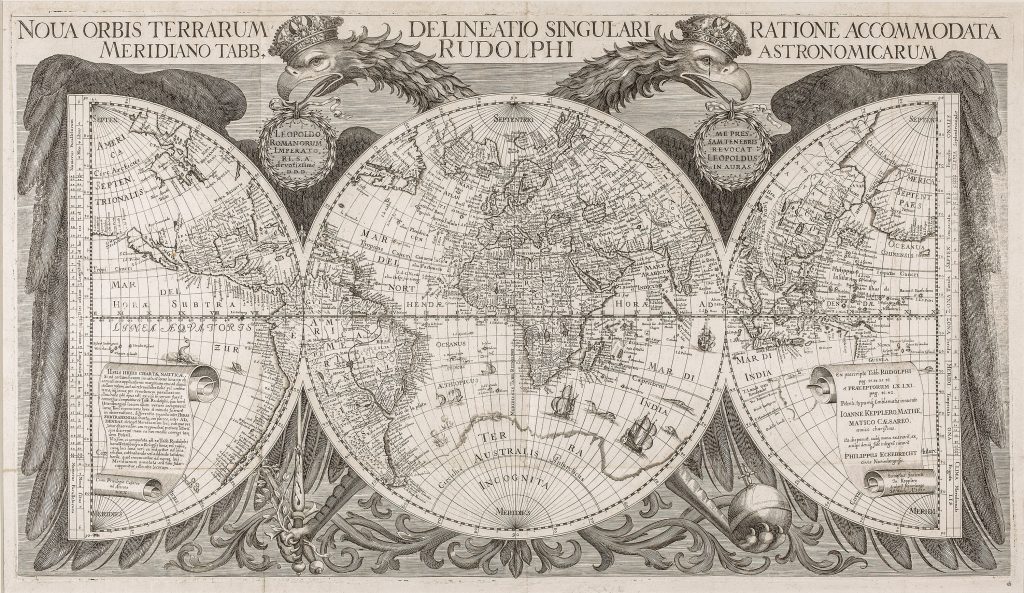
Philipp Eckebrecht was a Nuremberg mathematician, astronomer, and cartographer closely associated with Johannes Kepler. This visually dramatic world map was conceived by Kepler for use with the Tabulae Rudolphinae, or Rudolphine Tables, first published at Ulm in 1627. The project was handed to Eckebrecht, who arranged and drew the map, and it was engraved in Nuremberg by Johann Philipp Walch. Although the plate is dated 1630, known published examples belong to the later issue dedicated to Leopold I, whose coronation as Holy Roman Emperor in 1658 gave new relevance to the map’s imperial imagery..
The map is dominated by the German imperial double-headed eagle, whose body and wings frame the three-part world image. The central hemisphere uses the meridian of Tycho Brahe’s observatory at Uraniborg as its prime meridian, while the remaining parts of the world are divided into two flanking half-hemispheres. This unusual arrangement reflects the map’s intended use with Kepler’s astronomical tables for the calculation of longitude.
The map incorporates evidence of early Dutch encounters with Australia, including discoveries on the western and northern coasts associated with Dirk Hartog in 1616, Frederick de Houtman in 1619, and Jan Carstensz. and Willem Joosten van Colster in 1623. New Guinea is incorrectly joined to Australia, and the geography of the southern hemisphere remains unsettled.
Peter Meurer’s discovery of a 1630 proof state in a copy of Kepler’s Tabulae Rudolphinae at the University Library of Kiel clarified the map’s complicated publication history. The proof shows the cartographic image in an advanced but unfinished state, before the addition of the full engraved title, the completed imperial eagle, and the later dedication to Leopold I. The map was therefore substantially prepared by 1630, but appears to have been revised and issued in its completed form only in 1658.
Eckebrecht, Philip (1594–1667)
Nuremberg: J. P. Walch, 1630
1658, first
1630 proof state recorded; known published examples are after 1658
Copperplate engraving
125
R1 Extremely rare - occasionally seen on the market