
A New Map of East India
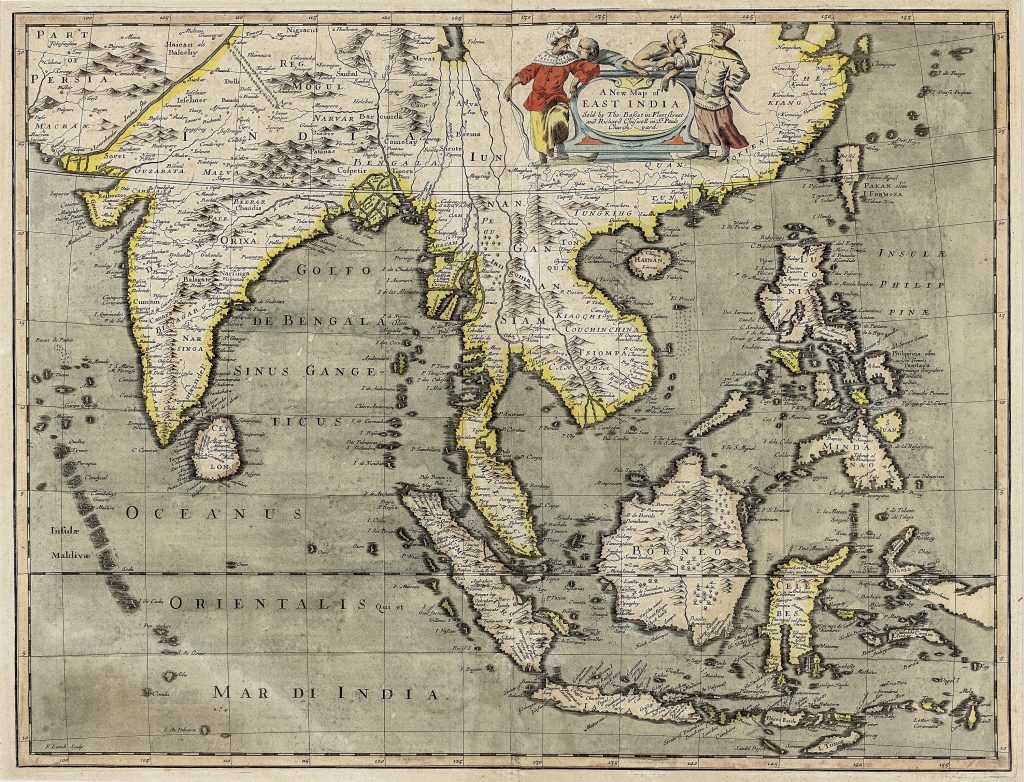
John Speed was an English historian and cartographer whose The Theatre of the Empire of Great Britaine and A Prospect of the Most Famous Parts of the World were among the most important English printed atlases of the seventeenth century. The former first published in 1612 by John Sudbury and George Humbl. The latter first published in 1611/12, was the most ambitious printed atlas of the British Isles produced in early Stuart England. Subsequent editions were released by William Humble in 1631/2 in 1646, 1650, and 1654. Later issued editions appeared in 1662 and 1665 by Roger Rea. The most notable version was published in 1676, when Thomas Bassett and Richard Chiswell published an expanded edition, adding seven new maps to the original twenty-one, including this map of Southeast Asia, China, Taiwan, and parts of India.
The map reflects the prevalent European belief that all major rivers in Asia originated from a single source, depicted here as the mythical Chiamay Lacus (Lake Chiamay). Four rivers are shown flowing south from this lake into Indochina, a configuration influenced by earlier cartographic works. This idea, popularised by Jesuit mapmaker Matteo Ricci, likely drew from European maps he brought to China as well as Bon Po and Buddhist doctrines.
The cartouche features four Asian figures, two of whom wear elaborate attire. On the left, a man with a moustache, turban, and bow is depicted, while on the right, a figure is dressed in traditional Chinese garments.
Speed, John (1552–1629)
A Prospect of the Most Famous Parts of the World, London: George Humble, 1627
1676, Bassett and Chiswell issue
Copperplate engraving
94