
Universi orbis descriptio ad usvm navigativm
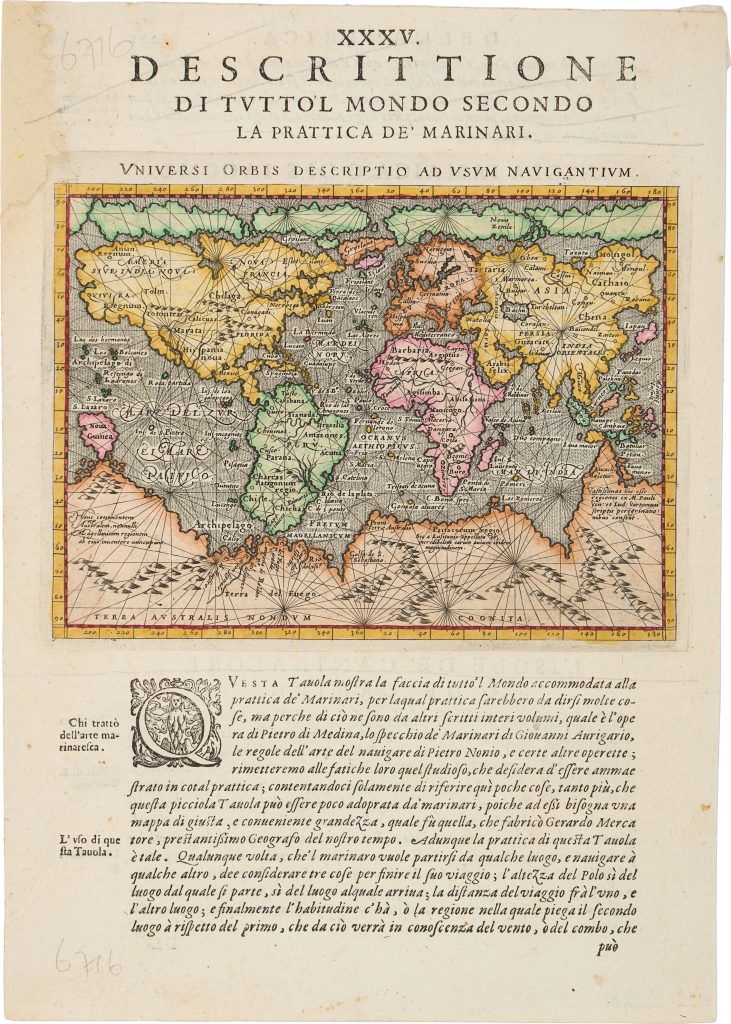
Giovanni Antonio Magini was an Italian mathematician, astronomer, astrologer, and geographer who held the chair of mathematics at the University of Bologna from 1588.
In 1596, he edited a Latin quarto edition of Ptolemy’s Geographia, published in Venice by the heirs of Simon Galignani as Geographiae universae tum veteris tum novae.
The maps, engraved by Girolamo Porro, were later reused in Leonardo Cernoti’s Italian translation, Geografia cioè descrittione universale della terra partita, published in Venice by Giovanni Battista and Giorgio Galignani in 1597–98.
This sheet belongs to that Italian edition, as shown by the Italian chapter heading and surrounding text.
This reduced world map was based on Gerard Mercator’s 1569 wall map of the world.
Like Mercator’s map, it presents the world for navigation, using a projection designed to help sailors plot constant compass courses.
Magini and Porro reduce Mercator’s large and complex image into a format suitable for an atlas volume, preserving its emphasis on oceanic movement, latitude, and the practical geography of navigation.
The geography retains several important features of Mercator’s map.
The Arctic is shown as a group of islands around the pole, while the southern hemisphere is dominated by a large conjectural southern continent.
South of Java appear Lucach and Maletur, names derived from Marco Polo and repeatedly absorbed into early modern ideas of the far south.
South of Africa lies Psitacorum regio, the “Region of Parrots, ” another inherited label attached to the geography of Terra Australis.
The Italain text beneath the map refers to navigational authorities, including Pedro de Medina and Pedro Nunes, and gives practical guidance for navigating between places.
This combination of map and text makes the sheet especially useful: it is not only a world image derived from Mercator, but a compact lesson in how mathematical geography and navigation were being presented to late sixteenth-century readers.
The verso text turns from the world map to the Caribbean, describing Jamaica, Cuba, and the Carib Islands.
These short regional accounts complement the map on the recto: while the map presents the world according to the “practice of mariners, ” the text gives readers more detailed information about particular islands within the Spanish Atlantic world.
The pairing is typical of Magini’s geographical method, in which maps and prose description work together to explain both the larger shape of the world and the character of individual regions.
Within the collection this sheet should be read alongside the coloured example of the same world map and chapter (135).
Magini, Giovanni Antonio (1555–1617)
Geographiae universae tum veteris tum novae, Venice: Heirs of Simon Galignani, 1596
1597–1598, Italian issue
Copperplate engraving
477