
Wittenberg world map
Hans Lufft was a Wittenberg printer and publisher closely associated with Martin Luther and the spread of Lutheran print culture.
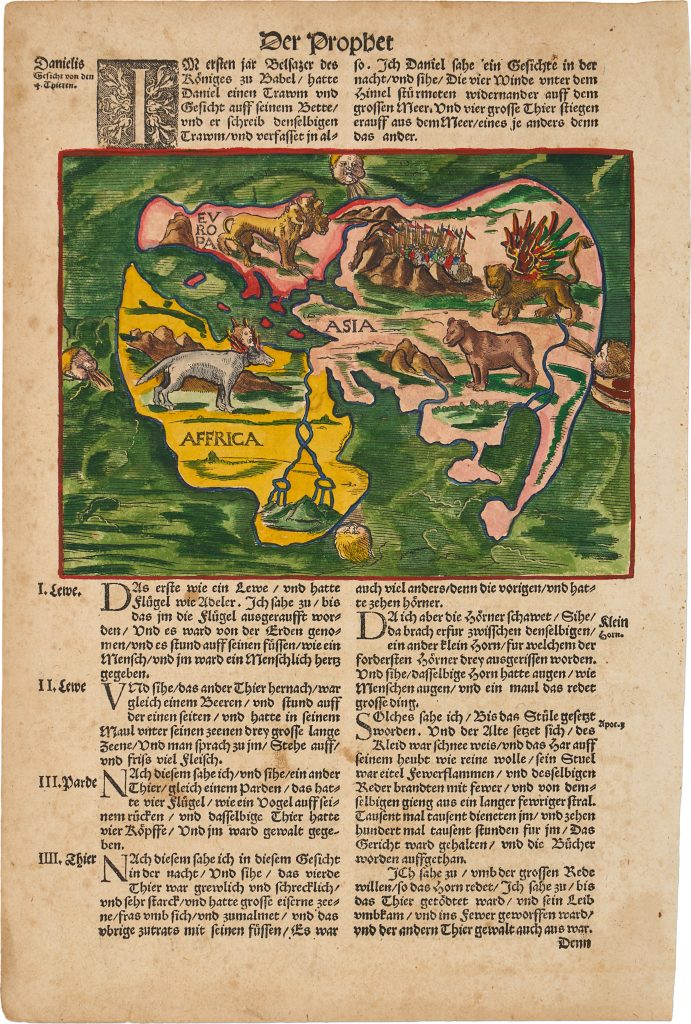
This small woodcut world map, commonly known as the Wittenberg World Map or Daniel’s Dream Map, was first published at Wittenberg in 1529 and later appeared in Lutheran biblical and theological works.
The present example belongs to a Magdeburg edition of 1545 or 1550.
The map illustrates the vision from Chapter 7 of the Book of Daniel, in which four beasts rise from the sea.
Europe, Africa, and Asia are shown in simplified form, surrounded by wind heads, clouds, and a turbulent ocean.
The four beasts are placed across the Old World: a lion, a bear, a four-headed leopard, and a horned beast.
Rather than presenting geography for navigation or travel, the map turns the world into a visual field for prophecy, empire, and divine judgement.
Its historical setting is important.
In Wittenberg, Daniel’s vision was interpreted in relation to the Ottoman threat to Christian Europe, especially after the Battle of Mohács in 1526 and the Ottoman siege of Vienna in 1529.
The map therefore joins biblical interpretation with contemporary politics, presenting the world through Lutheran apocalyptic thought.
The geography is deliberately schematic.
The map shows only the Old World, with Europe, Africa, and Asia reduced to a simple outline.
Helmink notes that the northern section reflects the Waldseemüller world map in the 1513 Strasbourg Ptolemy, while the southern section draws on Peter Apian’s 1530 heart-shaped world map.
The result is not a measured world map but a theological image built from recognisable geographical forms.
Lufft, Hans (1495–1584)
Martin Luther, Der Prophet Daniel, Wittenberg: Hans Lufft, 1529
1529, first state of the first block
Woodcut
476
R1 Extremely rare - occasionally seen on the market